

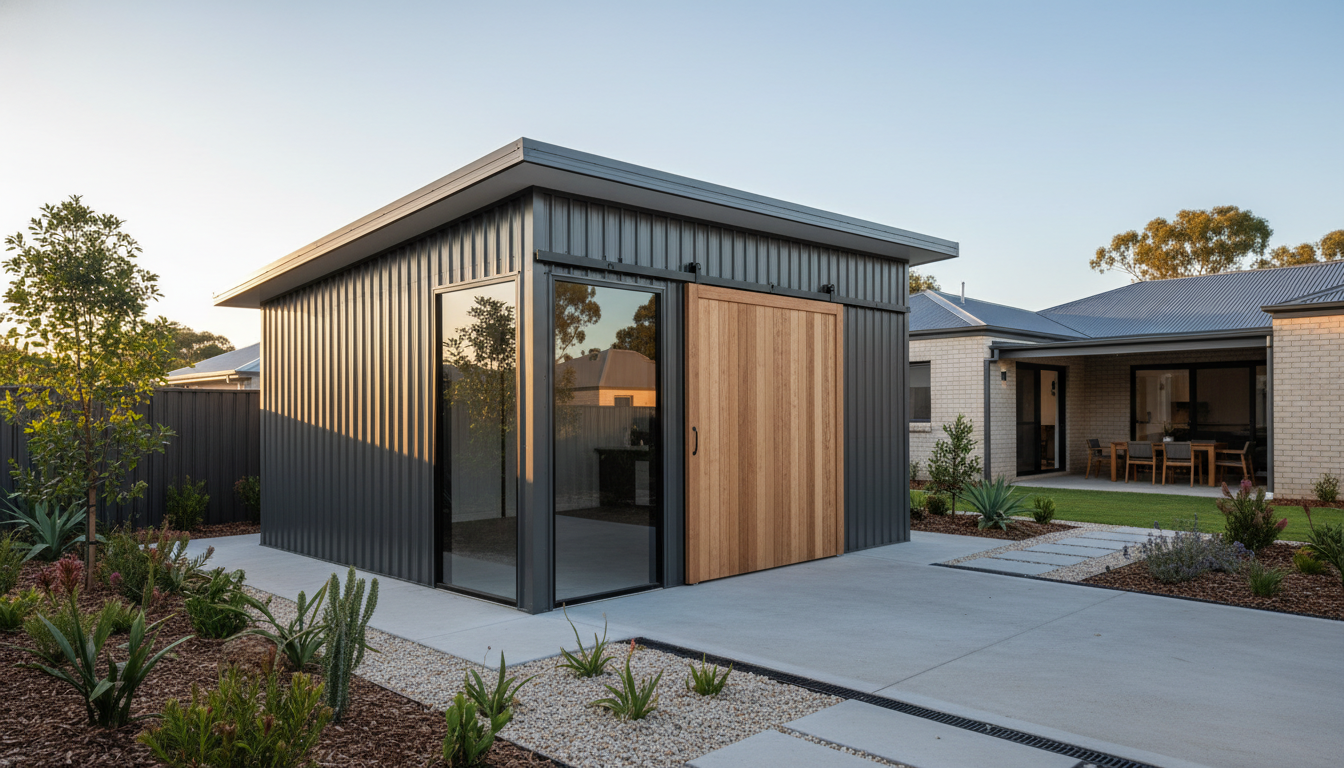

Designing a contemporary storage shed that lasts in Australian conditions
A modern storage shed should look sharp, perform in harsh weather, and add value. Below, we unpack materials like Colorbond steel, wind ratings for cyclonic areas, bushfire BAL compliance, drainage, ventilation, and the council pathway—so your architectural garden shed goes from sketch to signed-off build without surprises.
What are the best shed materials for Perth’s climate?
For Perth’s hot summers and coastal salt air, most premium modern sheds use BlueScope steel cladding—either Colorbond or Zincalume—over a galvanised, cold-formed steel frame. Powder-coated aluminium windows and doors, plus marine-grade fasteners, help resist corrosion on the coast.
Colorbond vs Zincalume — Which is better for WA conditions?
| Factor | Colorbond | Zincalume |
|---|---|---|
| Coastal resistance | Excellent with correct grade; pair with marine-grade fasteners and maintain wash-down zones | Very good; may show patina; requires careful detailing near surf/coastal spray |
| Heat reflection | Light colours reduce heat load; good for Perth summers | Highly reflective in raw state; can produce glare |
| Aesthetics | Contemporary palette complements architectural garden sheds | Industrial look suits modern shed designs with minimalism |
| Maintenance | Low; periodic wash-down | Low; can be painted later |
| Cost | Typically higher than Zincalume | Generally more economical |
For harsh coastal zones, reference AS/NZS 2312 for protective coatings and use fasteners to AS/NZS 3566.1. Many Perth clients choose light Colorbond tones with insulated roof panels to cut radiant heat inside modern garden sheds.
How does a modern storage shed differ from a traditional backyard shed?
- Clean lines: Skillion or flat roof profiles, concealed box gutters, and flush door sets.
- Architectural cladding: Standing seam profiles, vertical rib, or smooth panels on shed sides for a contemporary facade.
- Glazing and ventilation: High louvre windows, polycarbonate skylights, and ridge vents to keep conditions dry and bright.
- Integrated storage: Mezzanine platforms, bike rails, surfboard racks, and tool walls.
- Smart access: Slimline roller doors, sectional panel doors, or aluminium hinged doors with keyed-alike hardware.
Which roof profile is right for your site and style?
- Skillion (mono-pitch): Signature modern look; great for solar; easy to direct water away; suits narrow setbacks.
- Flat roof shed (with box gutter): Crisp silhouette; demands quality overflow provisions and leaf-guarding.
- Gable roof: Classic, strong in high wind when detailed correctly; extra headroom for mezzanine storage.
In heavy rain areas, size gutters and downpipes to NCC 2022 and AS/NZS 3500 stormwater. Include overflow spouts and avoid ponding to extend paint life on shed sides.
What wind rating, BAL level, and footing design do I need?
Engineering for sheds uses AS/NZS 1170.2 (wind actions). Your site’s wind region (A–D), terrain category, and topography govern design pressure and tie-down. Non-cyclonic suburbs are often N2–N3; North QLD and parts of WA use C1–C2 for cyclone-rated sheds. Bushfire zones are classified by BAL (e.g., BAL-12.5, BAL-29, BAL-40, BAL-FZ) with cladding and ember protection requirements per AS 3959.
Added 2024 WA wind-rating compliance notes For council-approved sheds WA-wide, ensure engineering covers Region A (Perth metro) and Region C/D for the north-west when relevant. Tie-downs should specify hold-down bolts, bracketry, and purlin/girt spacings to AS/NZS 4600. In cyclonic zones, use external door wind-locks and certified roller doors.
Typical slabs are 100–120 mm reinforced concrete with thickened edges at door openings; consult an engineer for soil reactivity (AS 2870 guidance). For sloping sites, consider piers and bearers with hot-dip galvanised stumps to AS/NZS 4680.
How do I get council approval and engineering certificates in my state?
Most modern sheds over small exempt sizes need building approval, site plan, structural certification, and sometimes planning consent (setbacks, heritage overlays). Provide wind classification, BAL if applicable, and stormwater management.
How to get council approval for your custom shed in WA
- Confirm planning rules (heights, boundaries, streetscape) with your local council.
- Obtain certified engineering to AS/NZS 1170.2 and NCC 2022; include footings and tie-down schedule.
- Lodge a Building Permit application (BA1 certified or BA2 uncertified) with drawings, site plan, and energy/lighting notes if powered.
- Address stormwater to AS/NZS 3500 with soak wells or connection to legal point of discharge.
- Book required inspections (footings/pour, frame if required, final).
Quick tips for VIC and QLD
- VIC: Check if your modern garden shed qualifies for a building permit exemption; if not, lodge with a Registered Building Surveyor; ensure siting compliance and amenity impacts are addressed.
- QLD: For cyclone-rated sheds QLD, use C-class wind design; some councils require planning for sheds forward of the building line. Roller doors must be wind-rated for design pressures.
What size and layout suit a contemporary storage shed?
- Small urban (2.4 m x 3.0 m): Bikes, garden tools, pool gear; 2.4 m shed sides; single glazed door + clerestory louvre.
- Medium (3.0 m x 4.5 m): Mower, workbench, surfboards; add ridge vent and skylight; upgrade to 2.7 m shed sides for racking.
- Large (6.0 m x 6.0 m): Home workshop or custom-built double garage in Perth with integrated storage; consider insulated roof panels and mezzanine.
- Rural (9.0 m x 7.5 m): Farm machinery storage with high roller door and heavy-duty purlins; optional lean-to for affordable carports for Australian homes.
Should you choose a DIY shed kit or a custom-built install?
DIY shed kits suit handy owners and straightforward sites: lower cost, fast delivery, and clear assembly manuals. Custom-built is best for architectural garden sheds with tricky sites, BAL or cyclonic constraints, or when you need turnkey council approvals, slab, power, and drainage handled.
- DIY shed kits: Economical, quick, great for non-cyclonic N2–N3 regions. Add-ons: anti-condensation blanket, vermin-proofing, and gutters.
- Custom install: Bespoke cladding, concealed fixings, higher wind ratings, and integrated glazing/insulation. Ideal for wind-rated sheds for cyclonic areas and heritage/planning overlays.
How much does a modern garden shed cost in 2025?
Indicative supply-and-install ranges (ex GST, site dependent):
- Small contemporary storage shed (around 2.4 x 3.0 m): $4,500–$8,500+
- Mid-size modern shed (around 3.0 x 4.5 m): $7,500–$13,500+
- Large workshop/garage (6.0 x 6.0 m): $16,000–$35,000+
- Cyclone-rated upgrade (C1–C2): +10–25% depending on doors, fixings, and engineering
Allow for slab, electrical, drainage, permits, and potential planning fees. Costs vary with cladding profile, Colorbond colour, glazing, and insulation. According to recent industry commentary from the Housing Industry Association and the Australian Steel Institute, steel pricing and labour availability in 2024–2025 remain stabilised but regionally variable.
What insulation, ventilation, and condensation control should you include?
- Roof: Anti-condensation blanket under roof sheeting or insulated roof panels for comfort and moisture control.
- Walls: R1.5–R2.5 bulk insulation with breathable sarking in cooler zones.
- Ventilation: Ridge vents, screened eaves, and automated louvres in humid climates.
- Seals: Door and wall vermin-proofing strips to reduce dust and pests in rural sheds NSW and SA.
Real-world examples from around Australia
- Perth, WA — Modern garden shed 3.0 x 4.5 m: Colorbond Monument, skillion roof, 2.7 m shed sides, insulated roof panels, louvre strip. Designed for Region A, N3. Client added a small solar array and bike rails.
- Townsville, QLD — Cyclone-rated shed 6.0 x 7.5 m: C2 design, wind-locked roller doors, extra hold-downs, and upgraded gutter overflows. Excellent airflow with ridge vent + screened eaves.
- Orange, NSW — Rural workshop 9.0 x 7.5 m: Zincalume with vertical rib cladding, gable roof, mezzanine storage, and vermin-proofing. BAL-12.5 compliant with ember screens.
What are the best add-ons for a modern look and easy use?
- Concealed box gutters and rectangular downpipes
- Aluminium windows and glazed doors with tinting
- Oversized roller doors or sectional doors for utes and boats
- LED task lighting, external sensor lights, and smart switches
- Architectural cladding mix: standing seam feature wall on street side
- Matching structures: custom carports Melbourne or custom Colorbond garages Perth for a unified streetscape
5-Step Buying Guide for Custom Sheds in Australia
- Define use and size: Tools, bikes, workshop, farm machinery storage? Sketch zones and heights.
- Confirm site constraints: Setbacks, easements, BAL, wind region, stormwater path.
- Choose materials: Colorbond vs Zincalume comparison, roof profile, insulation, door types.
- Get certified engineering: AS/NZS 1170.2 wind, AS/NZS 4600 steel design, and footing details.
- Submit approvals and book trades: Council/planning, slab, erection, electrical, and final inspection.
FAQs
Do I need a permit for a small modern shed?
Often yes, unless it meets exempt size/height rules in your state. Always check local planning and building requirements.
What wind rating should I specify?
Your engineer will assign N (non-cyclonic) or C (cyclonic) classification using AS/NZS 1170.2 and local maps. Don’t guess—site exposure matters.
Will steel framing attract termites?
Steel is termite-proof. You still need to manage landscaping and ant caps around adjacent timber structures.
How do I protect against coastal corrosion?
Pick appropriate Colorbond grade or Zincalume, use marine-grade fasteners, keep wash-down zones clean, and avoid dissimilar metal contact.
What about bushfire compliance?
In BAL areas, include ember screens, compliant glazing, and appropriate seals per AS 3959. Colorbond steel cladding performs well when detailed correctly.
Can I add solar to a skillion roof?
Yes. Skillion roofs are ideal for PV. Ensure purlin spacing and fixings suit panel rails and maintain roof warranty conditions.
What’s the typical lead time?
Design and approvals: 2–6 weeks. Fabrication and delivery: 2–5 weeks. Installation: 2–10 days depending on size and weather.
Ready to design your modern storage shed?
From sleek Perth garden sheds to cyclone-ready builds in North QLD, a properly engineered Colorbond steel shed adds function and value. Whether you want DIY shed kits or a turnkey, council-approved package, specify wind rating, BAL, insulation, and drainage up front to avoid rework and cost blowouts.