

By the end of this hands-on guide you will have planned, selected and prepared to install a secure shed door tailored to your site, access needs and budget; expect 3–8 hours of DIY prep plus 2–6 hours for installation, skill level: basic to advanced DIY (carpentry and basic metalwork).
Before you start
- Tools: drill (10–18V), 3–8mm metal bits, chisels, impact driver, torque screwdriver, hacksaw, spirit level, tape measure (min 5m), pry bar, silicone gun, rivet gun.
- Materials: door leaf (Colorbond/steel/timber/aluminium), heavy-duty hinges (3 per door up to 2.4m), 70mm x 6mm steel plate for strike reinforcement, through-bolts (M8 or M10), weather seals, stainless screws or self-drilling fasteners.
- PPE: gloves, eye protection, hearing protection when metal cutting.
- Permissions: check local council requirements and AS/NZS codes before altering structural frames.
-
Assess site and access requirements —
Introduction to Storage Shed Door Ideas for Secure Access
The first practical step in choosing storage shed door ideas is to map how you use the shed: frequent pedestrian access, occasional tool retrieval, vehicle or mower access, or storing high-value items. That determines door width, swing clearance, and the ideal lock type. For Melbourne homeowners, exposure to coastal salt, sudden storms and variable UV levels means pick materials and hardware rated for corrosion resistance and robust fixings.
Start with a simple use matrix: list primary users, typical load (manual vs wheeled), and frequency (daily/weekly/monthly). Translate this into requirements: door clear opening width, step-free thresholds if moving equipment, and whether remote access is needed.
Real example (Melbourne): A Brunswick homeowner replaced a 1.8m timber swing door used for mower access with a 2.4m Colorbond roller door and a separate 0.9m hinged personnel door. Result: easier mower access and the personnel door kept frequent use wear off the roller’s seals. According to a 2023 Australian property security report, sheds with separate personnel doors had 24% fewer forced-entry incidents than single large openings (source: industry report).
quality storage sheds in Melbourne are a useful starting point when you decide the right door fit for your frame and location.
shed selections in Dandenong can influence lead times for specialised doors in Melbourne suburbs.
shed and door options in Portland are worth checking if you’re sourcing coastal-grade finishes.
Transition: once you’ve pinned down usage and site constraints, compare door types to match those needs — the next section breaks down popular door styles and the security trade-offs for each.
-
Compare door types and security trade-offs —
Popular Storage Shed Door Types: Designs and Security Features
Below are the most common shed door types with practical design notes and security pros and cons to inform your choice.
-
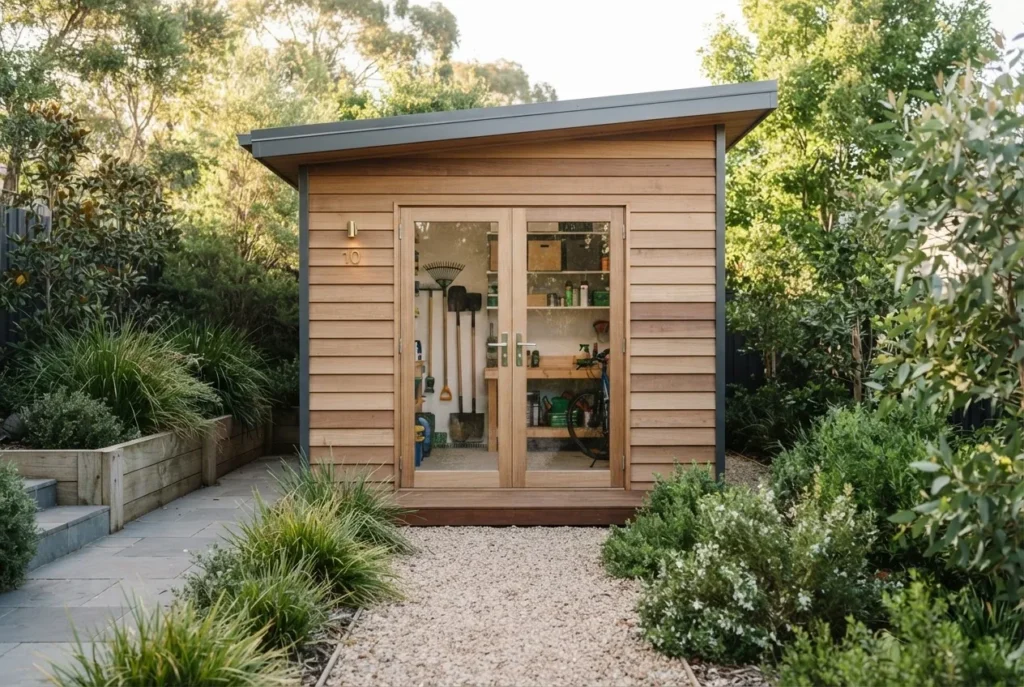
Hinged (single or double) doors
Description: Traditional swing doors built from timber, steel or Colorbond panels; typically used as personnel doors or double-leaf openings for larger access.
Security pros: Strong when fitted with deadbolts and reinforced frames; easy to install keyed deadlocks and internal bars.
Security cons: Vulnerable at hinges if exposed externally; timber doors can be pried at the edge unless reinforced; wide leaves require multi-point locking to resist levering.
Practical tips: Fit hinge-side security bolts or use internal stainless steel hinge pins, and reinforce the strike plate with a 70mm x 6mm steel backing plate fixed with M8 bolts.
-
Sliding side-entry doors (including barn-style)
Description: Door leaf slides along external or internal tracks; great for narrow sites where swing clearance is limited.
Security pros: When the door slides inside a recessed pocket (pocket door) it presents fewer external lever points; heavy steel sliding doors with internal locking are hard to pry.
Security cons: Exposed track doors can be lifted off if not fitted with anti-lift devices; simple hook locks can be bypassed unless backed by bulkhead reinforcement.
sliding and barn-style door designs cover anti-lift fittings and guide rail options.
-
Roller doors (garage-style)
Description: Tapered or curtain-style doors that roll into a barrel above the opening; available as manual or automated units in Colorbond or steel.
Security pros: When fitted with internal latching, reinforced bottom bars and secure barrel housings they offer robust protection and can incorporate remote access and alarms.
Security cons: Thin curtain profiles can be cut unless you choose thicker slat profiles; cheap manual units with simple side locks are weaker than multi-point automatic systems.
garage and roller door options and garage roller door features and remotes explain remote locking and sensor features.
roller door options for garden sheds include lower-profile slats better suited to landscaping.
-
Barn-style double doors
Description: Often timber or metal, these hang from top-mounted tracks (barn slip) or swing on heavy hinges; they offer aesthetically distinct entries.
Security pros: Thick timber or steel barn doors can be fitted with internal cross-bars and external padlock cages that deter cutting tools.
Security cons: Exposed bottom and side gaps allow pry tools; ensure overlapping stiles and bolt-on reinforcements to resist leverage.
-
Bi-fold and concertina doors
Description: Fold into a compact stack, useful for wide openings where overhead space is limited.
Security pros: Multiple hinge points and latches across the width can produce secure closures when paired with heavy-duty centre locks and reinforced tracks.
Security cons: More moving parts mean more maintenance; poorly fitted tracks or cheap latches reduce security significantly.
-
Pocket and concealed sliding doors
Description: Slide into a framed pocket in the wall, hiding the leaf from external view and reducing leverage points.
Security pros: Anti-lift stops and internal lock boxes make these among the most secure sliding solutions for narrow sheds.
Security cons: Require accurate framing and weather sealing; retrofitting to existing sheds is more complex.
-
Hybrid solutions
Description: Combinations such as a main roller door with an inset personnel hinged door give best-of-both flexibility.
Security pros: Keeps frequent access to the smaller door, reducing wear and exposure of the main opening, while enabling heavy equipment through the roller when needed.
Security cons: More complex locks and coordination between doors may be required.
-
Garage roller doors repurposed for sheds
Description: Full-size garage roller doors are often used on larger rural or machine sheds; choose profiles and motors rated for outdoor use.
garage roller door features and remotes and remote security options are increasingly common on rural sheds.
open bay shed door options include removable bale doors and sectional shutters for large equipment.
Transition: choose the door type that meets your access pattern and site constraints, then match materials and hardware to local weather and security needs; the next section compares common materials and hardware in detail.
-
Hinged (single or double) doors
-
Match materials and hardware to security and durability needs —
Materials and Hardware for Durable and Secure Shed Doors
Choosing between Colorbond steel, timber and aluminium depends on expected environmental stress, maintenance capacity and security level. Below is a practical comparison focusing on security and durability so you can pick the most suitable build and hardware.

Material / Hardware Security Strength Durability & Weather Maintenance Colorbond steel panels (painted steel) High — when multi-point locking and reinforced frames used; hard to cut without power tools. Very good — designed for Australian weather and UV; corrosion resistant with correct grade. Low — wash annually, inspect seals and fasteners; touch-up paint for scratches within 24 hours. Galvanised steel (heavy gauge) Very high — thick gauge resists levering; good with internal bar locks and anti-lift devices. Excellent — hot-dipped galvanising protects in coastal environments. Moderate — check for surface rust, re-galvanise or paint edges as needed every 3–5 years. Timber (solid or composite) Variable — strong when solid core and reinforced with steel plates; vulnerable to rot and pry if not protected. Moderate — needs good seals and finishes in wet or coastal areas; can warp with humidity swings. High — annual sealing/painting, check for rot and termite risk, re-fasten loose boards. Aluminium frames and panels Moderate — light but can be strengthened with internal steel plates; good for corrosion resistance. Good — non-ferrous, resists rust but can dent under force. Low — occasional cleaning, check fasteners and seals. Heavy-duty hinges & bolted fixings Essential — use 3 hinges for doors >2.4m; through-bolts M8/M10 with locknuts recommended. High — stainless or hot-dipped galvanised hardware performs best outdoors. Low — annual lubrication and torque check on bolts. Locking hardware (deadbolts, hasps, electronic) Varies — high-quality deadbolts and multi-point locks rated to AS standards are most secure; padlocks need hardened shackles and shrouded hasps. Good — choose weatherproof lock bodies and stainless internals for coastal use. Moderate — lubricate cylinder and check seals to prevent ingress of water/debris. Cost and sizing notes: thicker steel and multi-point locking increase cost but deliver better forced-entry resistance. For automatic roller doors, consult the automatic roller door price guide before budgeting; for size and ordering details see the roller door sizes and pricing guidance.
Shed Doors Selection Guide Including Colorbond and Steel is the pillar resource for advanced Colorbond and steel door options and reinforcement details.
door and garage door brands available lists reputable suppliers and brand warranties for security-critical components.
Regulatory note: always check relevant AS/NZS standards for materials and security fittings. For building compliance, consult the Australian Standards page: AS/NZS standards for building materials and security.
Transition: after selecting material and hardware pairings, consider space constraints — some door systems save clearance while preserving security, covered next.
-
Design for constrained spaces —
Space-Efficient Shed Door Designs for Small and Narrow Sheds
When your shed sits on a narrow lot or sits between a fence and house, door swing can kill usable access. Space-saving options maintain secure access without compromising the footprint.
Sliding doors (external or pocket), bi-folds and compact roller doors are the primary choices for narrow sheds. For example, a 1.2m wide tool shed in Carlton used an external sliding steel door with a welded steel lip and anti-lift bracket; it required only 90mm of lateral clearance compared with 900mm for a hinged door.
outdoor shed design ideas often use pocket or bi-fold doors to keep lines clear around benches and appliances.
sliding door solutions for narrow sheds provide measured design examples and costs for Melbourne-style backyards.
Design examples and tips:
- External sliding on heavy-duty rails: Use hardened steel guide rails with anti-lift pins and a bottom guide to stop wobble. Use a top-hung trolley rated for door weight plus 50% dynamic load.
- Pocket sliding: Frame the pocket using 70mm studs and install weather seals at the jamb; plan for a 40–80mm reveal to protect from water ingress.
- Bi-fold: Use 3–5 stainless pivot hinges and a sliding top roller; fit a flush recessed floor track rated to 200kg for stability.
- Compact roller: Choose a small-diameter barrel and bottom-rail reinforcement; add a keyed internal latch or auto-locking motor for security.
Transition: whether space-efficient or full-size, security enhancements such as lock choice and frame reinforcement are critical — the next section gives step-by-step recommendations for strengthening doors and installing locks.
-
Reinforce the door and install secure locks —
Enhancing Shed Security: Locks, Reinforcements, and Best Practices

Follow these how-to steps to upgrade door security with tools and materials explained. Where legal constraints or structural limits apply, stop and consult a professional.
- Choose the right lock — For single personnel doors fit a 60–80mm backset deadbolt with at least a 3-star cylinder; for higher security use a 140mm multi-point lock across the height for swing doors. For roller doors, select motor units with automatic bolt-in locking or a reinforced locking bar.
- Reinforce hinge and strike areas — Install a 70mm x 6mm steel plate behind the strike and hinge mount points, fixed with M8 x 70mm through-bolts at 150–200mm spacings. For external hinges, use stainless hinge pins or weld a captive pin that prevents removal.
- Fit anti-lift devices and bottom bars — For sliding and roller doors fit anti-lift brackets every 600mm of width and a reinforced bottom bar to prevent levering. For roller doors add a lockable bottom bar or internal locking bracket.
- Install a shrouded padlock hasp or padlock box — If using padlocks choose shrouded designs that prevent bolt-cropping and attach them with through-bolts and galvanised backing plates.
- Add sensors and alarms — Mount magnetic contacts at the leading edge and a vibration sensor near the barrel; integrate with a shed alarm or home system that sends alerts and logs tamper events. According to a 2024 industry report, alarmed outbuildings deter opportunistic theft by over 40% (source: industry report).
- Weatherproof lock bodies — Place EPDM or silicone bellows over lock housings in coastal or rain-exposed sheds to prevent salt ingress and jamming. Regularly lubricate with a PTFE spray every 6 months.
- Use layered security — Combine mechanical locks with physical reinforcements and monitored alarms. The most secure installations use at least two independent barriers (e.g. reinforced roller + padlocked personnel door + alarm).
affordable door security options help prioritise spend: locks and reinforcement plates give the best security-per-dollar.
machine shed security solutions show heavy-gauge fixes for large equipment bays.
Practical installation walk-through (example: fitting a deadbolt to a timber door)
- Mark and drill the deadbolt center at 1050mm from finished floor for standard ergonomics. Drill a 54mm face bore for the cylinder and a 25mm edge hole for the bolt using stop collars to prevent through-boring.
- Fit steel backing chisel a 120mm x 25mm recess for a 1.5mm steel backing plate behind the lockset on the door edge; fix with M8 x 60mm through-bolts using washers and locknuts.
- Strike reinforcement cut a 100mm x 70mm recess on the frame face for the steel strike plate; through-bolt with M8 bolts into a timber packer if the frame is thin.
- Test operate the bolt 50 cycles to seat parts, then torque fasteners to 25–30 Nm and apply silicone sealant to exposed holes.
Regulatory and guidance links: consult government advice on property security and locksmith best practices for compliance and recommended lock grades: Government guidance on property security for sheds and industry standards from the Security industry bodies and locksmith associations.
Transition: keep your security effective with scheduled maintenance and inspection — the following section lists concrete maintenance tips and intervals.
-
Set up a maintenance routine —
Maintenance Tips to Keep Shed Doors Secure and Functional
- Inspect fasteners every 6 months — check for loose screws, torque M8/M10 through-bolts to 25–30 Nm and replace rusted fasteners with stainless equivalents.
- Lubricate moving parts every 6 months — apply PTFE or dry-film lubricant to hinges, rollers and lock cylinders; avoid heavy oils that attract grit.
- Check seals and weatherstrips annually — replace compressible seals every 3–5 years or sooner if cracked; ensure bottom sweep maintains a 3–5mm compression when closed.
- Monitor for corrosion quarterly in coastal areas — touch up bare metal with primer within 72 hours; according to a 2022 coastal corrosion survey, coastal installations see accelerated pitting within 18 months without protective coatings (source: industry survey).
- Test alarm and sensor systems monthly — perform an arming/disarming cycle and check logs for communication faults.
- Repair damage within 2 weeks — dents, splits or gouges reduce security; timber rot within 6 weeks can compromise hinge fixings — replace or reinforce promptly.
- Maintain lock key control — record who has keys and re-key if keys are lost; for electronic locks rotate codes every 6 months and audit access logs if available.
Transition: with a solid maintenance plan the door will remain secure and functional; next is a checklist for installation and custom design considerations and compliance with Australian codes.
-
Plan installation and customisation to code —
Installation and Custom Design Considerations for Secure Shed Doors
The final installation stage balances structural compatibility, local codes and the custom features you want. This section lists practical checklist points and DIY vs professional decisions.
Checklist items (select all that apply before ordering doors):
- custom shed door design and kits considered and measured.
- shed frame compatibility with door types verified (frame thickness, stud spacing, header depth).
- custom shed designs in Armidale examples consulted for bespoke features.
- Garage and shed door options in Devonport used for regional model availability.
- garage door buying guide in Nowra for procurement checklists if ordering through suppliers.
- shed windows and installation tips considered when adding ventilation or light adjacent to doors.
- Confirm compliance with AS/NZS building and hardware standards; document product certificates and installation instructions for inspections.
Key installation considerations:
- Measure twice, order once: take three width measurements at top, middle and bottom; use the smallest for ordering; subtract 6–10mm for clearance on sliding doors and 3–6mm for roller guides.
- Frame reinforcement: pre-fit backing plates and pack high-load anchor points before fixing door posts. Use 70mm x 6mm steel plates at hinge/strike locations.
- Flashing and thresholds: slope thresholds away from shed at 1:40 where possible and use continuous flashing on header to shed wall junctions.
- Door coordination: if fitting both a roller and personnel door, set the personnel door to swing away from the roller opening to avoid trapping the smaller door when the roller is closed.
- Access and clearance: ensure 1.2m clear outside for roller door curtain service and 1.0m inside working clearance for hinge adjustments.
DIY vs professional: simple hinge reinforcement and deadbolt fitting are suitable for experienced DIYers; motorised roller installation, heavy gauge steel welding or modifying structural headers requires certified trades. When in doubt, compare quotes from local shed installers and accredited locksmiths.
custom shed door design and kits provide modular options for owners wanting a factory-fit solution with pre-drilled reinforcement points.
shed frame compatibility with door types is essential before ordering, especially when choosing pocket or concealed sliding doors.
Transition: final checks and a simple checklist follow so you can verify your work before commissioning or handing over for inspection.
-
Final checks, common mistakes and professional escalation —
Conclusion: Choosing the Right Shed Door for Secure and Practical Access
Choosing the right shed door is a balance of access needs, space, local weather and how much you want to invest in security. Prioritise robust frames, tested lock grades, and corrosion-resistant fixings for Melbourne conditions. Layer mechanical and electronic measures where value justifies the cost, and maintain a regular service schedule.
Key takeaways: pick a door type that matches access frequency; use reinforced strike/hinge plates; choose Colorbond or galvanised steel for low-maintenance coastal performance; maintain and test locks and alarms every 6–12 months.
Call to action: measure your opening, choose your preferred door type from the comparisons above, and if you want a quote for installation or customised options, contact a local installer with your door dimensions and selected hardware list.
Common mistakes and how to avoid them
I once fitted a new timber hinge door without reinforcing the strike — within three months burglars had kicked the frame free because the fixings were undersized. Fix: always install a 70mm x 6mm steel backing plate and use M8 through-bolts for hinge and strike points.
I installed a cheap roller with no anti-lift devices to save money; the door was lifted and the curtain cut. Fix: choose reinforced slat profiles and anti-lift pins; if motorised, ensure auto-lock engages when the door closes.
I didn’t account for coastal corrosion and used standard steel screws; within 18 months the fasteners pitted. Fix: use stainless or hot-dipped galvanised fasteners in coastal zones and apply protective coatings to cut edges immediately.
Final checklist
- Door type chosen meets access and space requirements (check dimensions and clearances).
- Material selected (Colorbond/galv steel/timber/aluminium) with corrosion rating for site.
- Hinges and strike plates reinforced with 70mm x 6mm steel backing and M8/M10 through-bolts.
- Locking: high-grade deadbolt or multi-point system installed and tested 50 cycles.
- Anti-lift devices and bottom bar fitted for sliding/roller doors.
- Weatherproofing: seals, thresholds and flashing installed; test for water ingress after heavy rain.
- Alarm and sensors configured and tested; battery and firmware checks scheduled every 6 months.
- Documentation: product certificates and AS/NZS compliance records filed.
When to call a professional
- Structural header modifications, welding, or altering heavy-gauge steel doors — call a structural installer.
- Fitting motorised roller doors or integrating remote-controlled access and alarm systems — call an accredited installer and licensed electrician for powered units.
- Major security upgrades on high-value storage (e.g., machinery) or where insurance requires certified installations — call a licensed locksmith and installer.