

Ironstone colour is a deep, muted grey in the Colorbond palette used for roofing and paint that balances modern neutrality with strong weather performance; it suits Melbourne sheds and homes where durability, fade resistance and understated aesthetics are priorities for long-lasting steel roofs and cladding.
Colorbond: a BlueScope-manufactured pre-painted steel product combining a zinc-aluminium alloy-coated steel substrate with proprietary paint layers for weather-resistant building applications.
Introduction to Ironstone Colour
Question: What does the Ironstone colour look like and why do builders choose it?
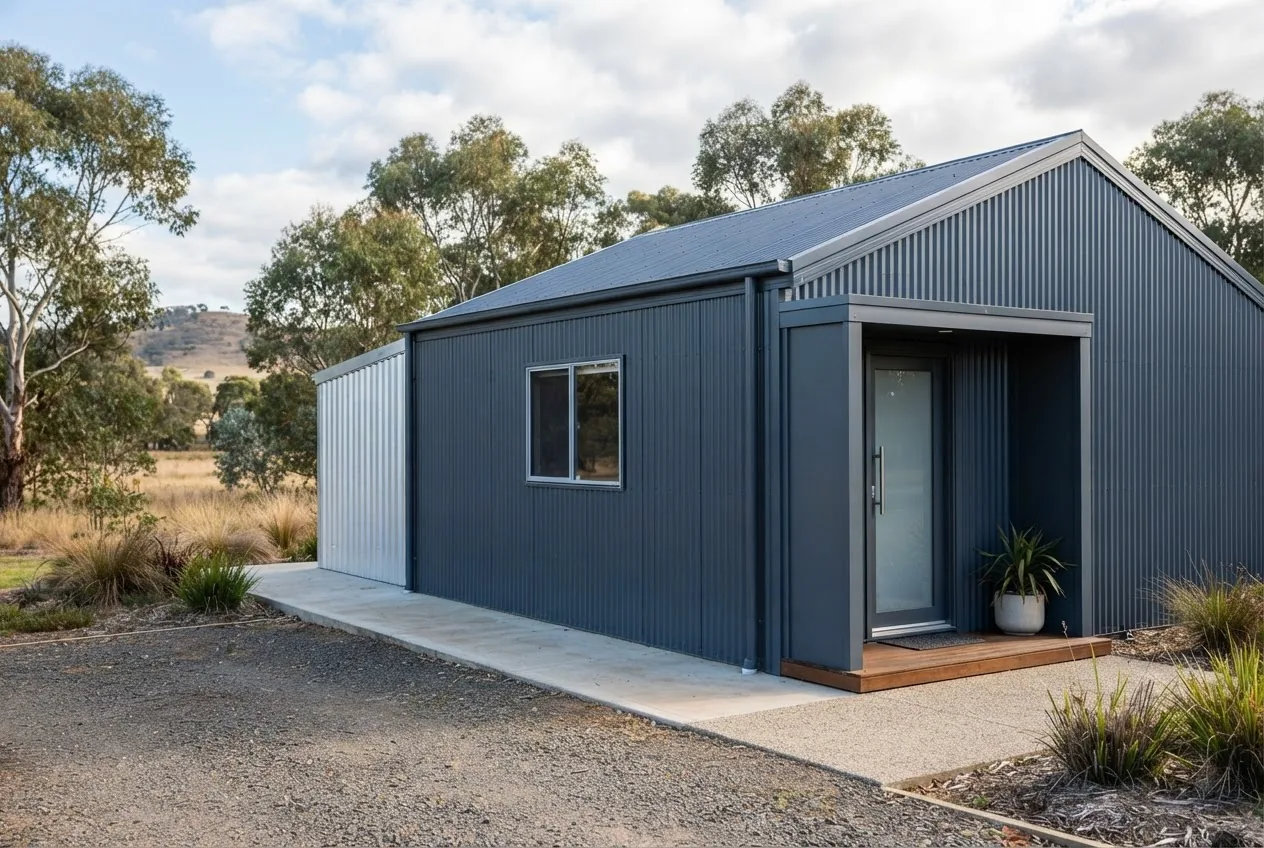
Answer: Ironstone is a deep, muted grey with warm undertones that reads almost charcoal from a distance and reveals subtle, neutral depth up close; it’s chosen for its architectural versatility, modern look and ability to reduce contrast against both light cladding and darker landscaping in Australian settings.
Ironstone sits in the Colorbond colour palette as a contemporary neutral — darker than mid greys but not as stark as black. Its muted tone avoids the high-gloss glare of lighter roofs while providing a clean backdrop for feature elements like timber accents or painted trims. In architectural styles across Australia, Ironstone complements:
- Modern suburban homes with minimal palettes (render, timber and steel)
- Rural sheds that need a low-profile roof against native vegetation
- Commercial outbuildings where longevity and low maintenance matter
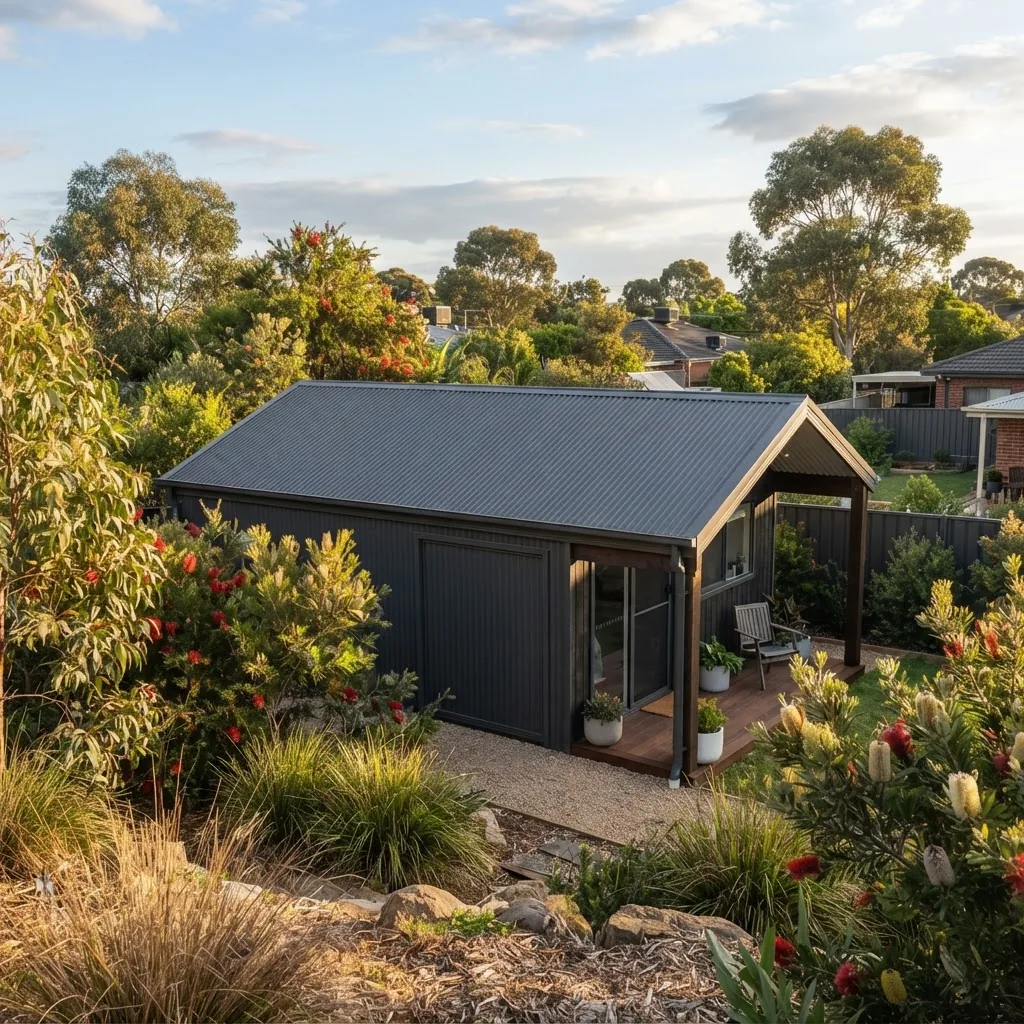
The perceived colour changes with finish type (matt vs standard Colorbond finish), time of day, and roof pitch; low-slope roofs present denser, darker tones. For a visual reference, see the media marker on the right below.
Transition: Having seen Ironstone’s appearance, the next section explains the paint system that gives it durability and the practical stats you’ll need for specifying Colorbond Ironstone paint.
Characteristics of Colorbond Ironstone Paint
Question: What are the technical paint and steel characteristics of Colorbond Ironstone and how durable is it?
Answer: Colorbond Ironstone uses BlueScope’s pre-painted steel system combining a zinc-aluminium alloy-coated steel substrate with multiple polymer paint layers for UV resistance, anti-corrosion protection and engineered fade resistance suitable for Australian climates.
Term: fade resistance — the measured ability of a paint film to resist colour change under UV exposure over time.
Colorbond’s paint technology for Ironstone comprises a chemical primer, a corrosion-resistant metallic coating (zinc/Aluminium alloy) and a topcoat with UV-stable pigments. Key characteristics:
- Substrate: high-tensile steel with a zinc-aluminium alloy coating for barrier corrosion protection.
- Paint finish types: Colorbond standard finish (satin) or Colorbond Ultra options depending on availability — finishes affect sheen and perceived depth.
- UV resistance: pigment formulations designed to resist UV breakdown; darker pigments like Ironstone require stable carbon black alternatives to limit fading.
- Anti-corrosion: multi-layer coating system protects cut edges and exposed fixings when installed and sealed correctly.
- Scratch and chip resistance: topcoat hardness varies by product grade — Colorbond Ultra grades offer improved abrasion resilience.
Short stat blocks:
- Typical expected exterior colour stability: 10–15 years moderate (depending on exposure) — According to a 2024 industry report on painted steel durability.
- Corrosion protection layer: zinc-aluminium alloy — continuous barrier per BlueScope technical approach.
- Common finish options: standard Colorbond finish; Colorbond Ultra for enhanced durability.
For deeper product-specific technical data, see the BlueScope product literature which details coating thicknesses, warranty conditions and testing thresholds.
BlueScope Steel technical data sheets provide the manufacturer specifications for Colorbond systems and recommended installation practices.
Transition: With the paint and substrate explained, the next section compares the benefits of using Ironstone on a roof and what to watch for during installation and service.
Ironstone Roof: Benefits and Considerations
Question: What are the main benefits and practical considerations of installing an Ironstone Colorbond roof?
Answer: An Ironstone Colorbond roof offers strong weather resistance, good thermal performance for dark colours when paired with appropriate insulation, and a modern aesthetic; considerations include potential heat absorption, visibility of dust and the need for correct flashing and installation to prevent corrosion at penetrations.
Below is a clear benefits vs considerations comparison to help decision-making:
| Benefits | Considerations |
|---|---|
| Durable, factory-applied paint with anti-corrosion substrate | Darker colours absorb more heat — must specify insulation for energy efficiency |
| Low-maintenance surface; resistant to rain streaking | Shows dust, lichen or salt deposits more readily in exposed locations |
| Versatile aesthetic for modern and traditional roofs | Requires correct flashing and capping to avoid edge corrosion |
| Good resale appeal due to neutral, contemporary look | Repainting or local repairs need matched pigments and prep for longevity |
Practical installation and maintenance notes:
- Thermal performance: Dark Ironstone roofs will transfer more heat into roof spaces if not insulated; specify sarking and bulk insulation to meet thermal comfort expectations in Melbourne summers.
- Weather resistance: Colorbond systems protect against typical rain, UV and wind loads when fastened and sealed per manufacturer recommendations; follow local building codes.
- Installation tips: Use compatible flashings, appropriate fixings and overlap details to protect cut edges; consider roof capping materials to finish ridgelines and hips properly.
- Costs and budgeting: For panel pricing alternatives and budgeting see the roof cost guide.
- Sheeting choice: For affordable panel options compatible with Ironstone consider suppliers listed in the cost-effective roofing sheets.
- Material upgrade: Selecting higher-grade paint systems such as Colorbond Ultra improves the lifespan—compare Colorbond Ultra Steel features for premium durability.
Warranty and compliance: Refer to Australian Building Codes and BlueScope technical specifications for permitted use of painted steel roofs in habitation projects. Australian Building Codes Board (ABCB) provides regulatory guidance on roofing materials and compliance.
Transition: With benefits and trade-offs clear, the following section shows how Ironstone compares visually and technically to Ironbark Colorbond.
Ironstone vs Ironbark Colorbond: A Colour Comparison
Question: How does Ironstone differ from Ironbark Colorbond in tone, suitability and appearance?
Answer: Ironstone is a cooler, deep neutral grey with subtle warmth, while Ironbark is a much darker, near-black brown-grey with stronger warm-red undertones; Ironstone suits contemporary schemes, Ironbark suits heritage or high-contrast palettes.
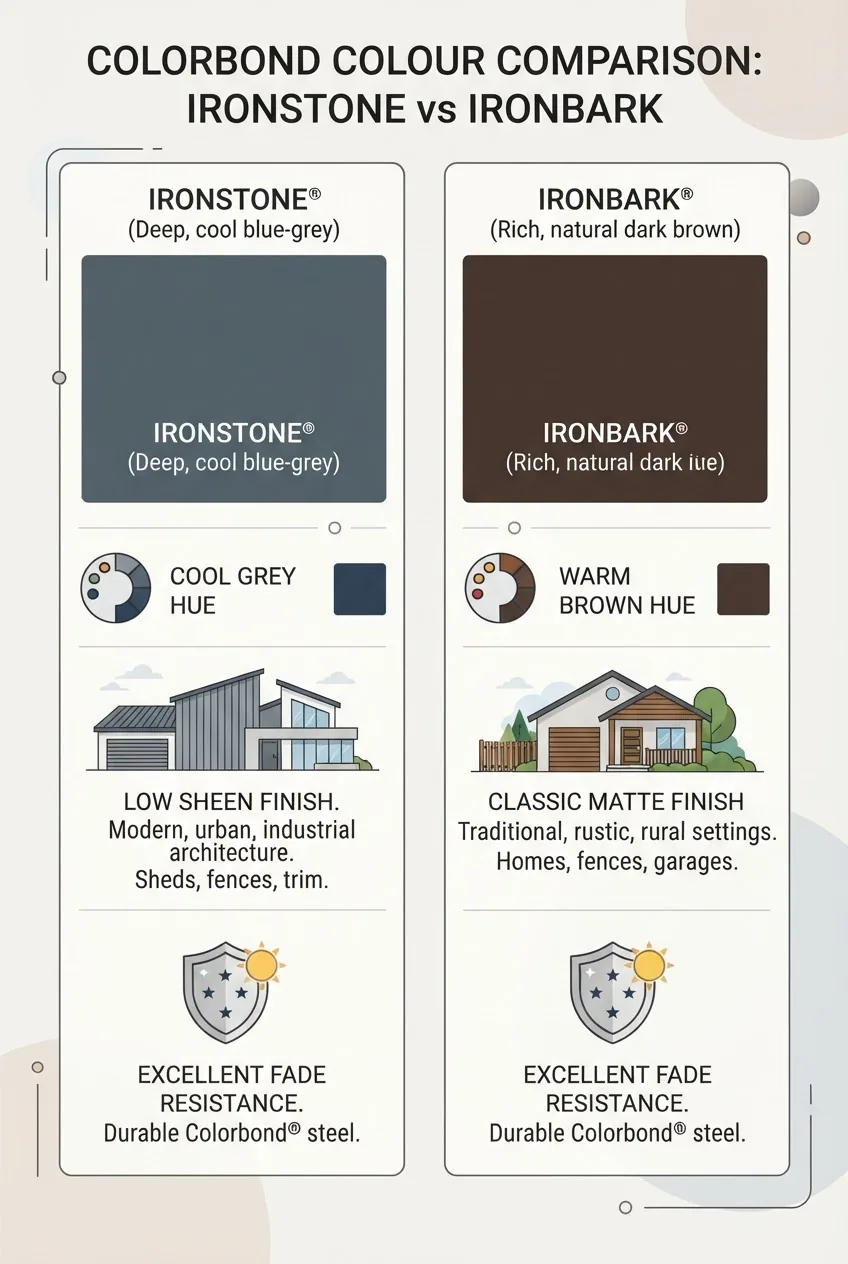
| Feature | Ironstone | Ironbark |
|---|---|---|
| Hue | Deep neutral grey, subtle warm undertone | Very dark brown-grey with red/warm undertones |
| Perceived brightness | Medium-dark, reads lighter at high pitch | Darker, near-black at distance |
| Best uses | Contemporary homes, neutral palettes, modern sheds | Heritage houses, strong contrast schemes, rustic cladding |
| Fade resistance (typical) | Good with UV-stable pigments | Good but darker pigments may reveal weathering differentially |
| Visual impact | Subdued, blends with both light and dark elements | Bolder, anchors facades with strong contrast |
Descriptive comparison:
Ironstone is often chosen when a project needs a contemporary, lower-contrast finish that complements lighter wall colours like Surfmist or pale renders; Ironbark is deliberately deeper and adds visual weight when paired with light cladding or timber features. Colour perception changes with finish and pitch — slate-like on low-pitch roofs for Ironstone, almost black for Ironbark.
For additional paint system comparisons and other popular colours (e.g., Blue Ridge), consult the Colorbond paint options.
Transition: Now that you can distinguish Ironstone from similar tones, we’ll look at practical uses for Ironstone in Melbourne’s varied climate and architectural mix.
Practical Applications of Ironstone Colour in Melbourne
Question: Where and how should Ironstone be used in Melbourne for best aesthetic and performance outcomes?
Answer: Ironstone works well on suburban and inner-city homes, modern sheds and outbuildings in Melbourne where its neutral tone harmonises with native landscaping; specify proper insulation and drainage for summer heat and winter damp, and consider matching fences and gates for cohesive presentation.
Term: sarking — a reflective or breathable layer installed under roof sheeting to improve thermal and condensation performance.
How Melbourne’s climate affects Ironstone:
- Hot summers: Ironstone absorbs more solar heat than light colours; pair with sarking and bulk insulation in ceilings to reduce heat transfer.
- Cold, damp winters: Ensure roof ventilation and condensation control to avoid moisture build-up under darker roofs.
- Variable weather and UV: Use UV-stable topcoats and maintain gutters to avoid staining from tannins and leaf litter.
Common building styles using Ironstone across Melbourne:
- Contemporary townhouses and renovated Victorians with monochrome palettes
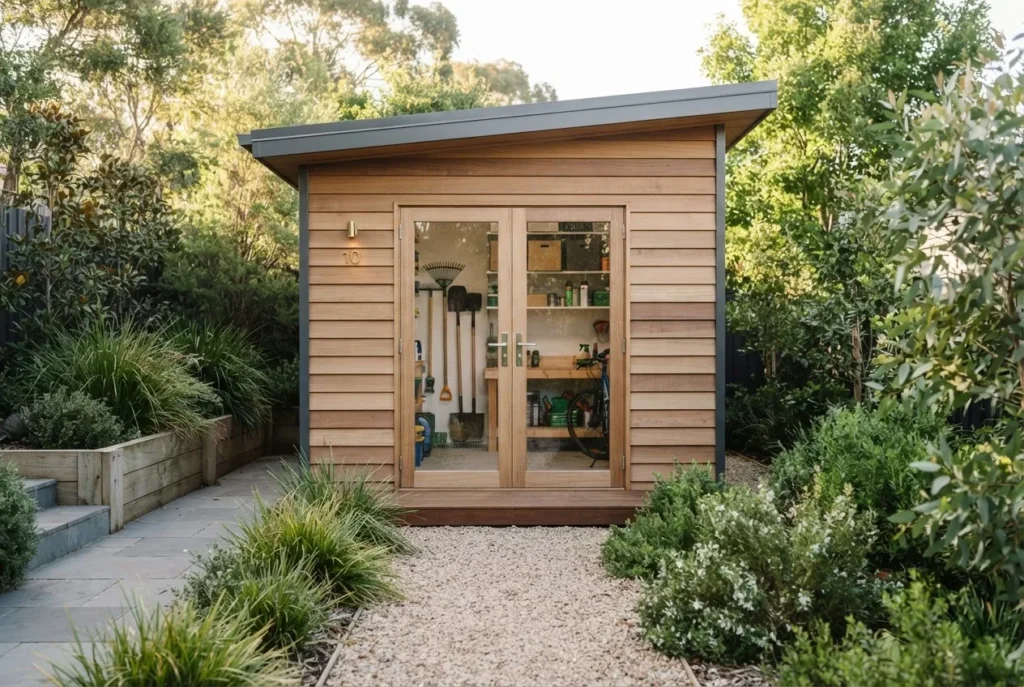
- Colorbond sheds in peri-urban properties where the roof blends into eucalypt backdrops
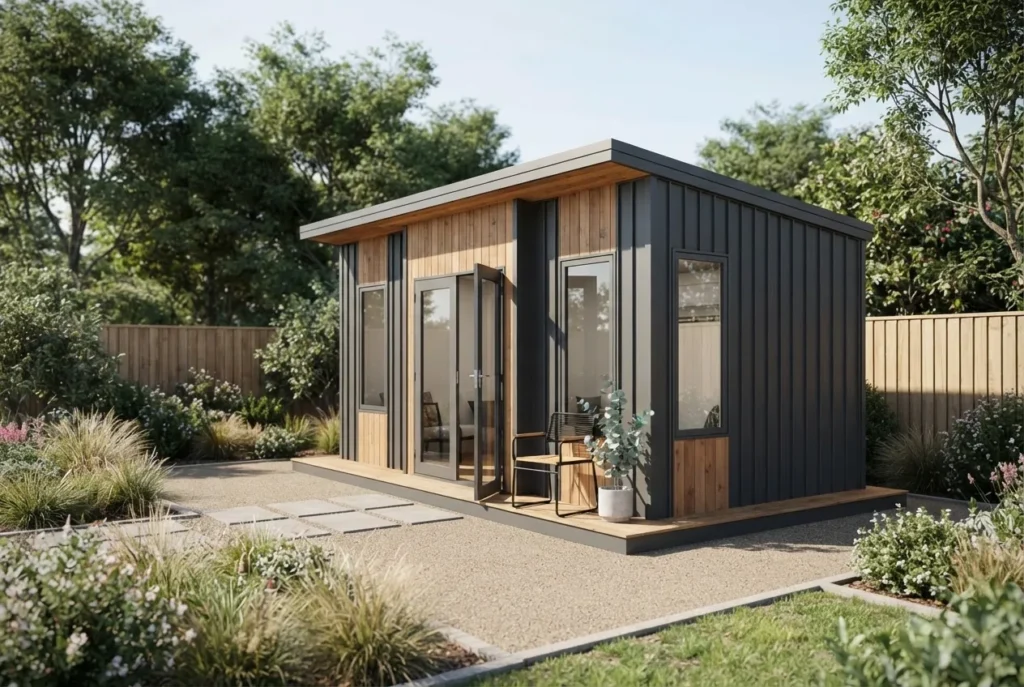
- Carports and pergolas matched to window frames and fascias
How to choose Ironstone for your project — step-by-step tool walkthrough in a local supplier setting:
- Inspect sample chips in the supplier yard at different times of day (morning, noon, late afternoon) to note hue shifts against sunlight and shadow.
- Request a 600mm x 600mm off-cut or sample panel painted in Ironstone to place on-site for a week to observe weathering and reflection.
- Compare finishes (standard vs Ultra) and note slight sheen differences; ask the supplier for technical datasheets to compare coating thicknesses.
- Check with your builder or installer about compatible flashings, gutter and fascia pairings; coordinate with fence and gate colours using matching guides for a unified look — for fencing, see Colorbond fencing materials.
- Budget for installation plus finishing items (capping, flashings, sealants) and compare quotes using the fence gate installation costs if matching gates are required.
Local example (real-world): In Melbourne’s Brunswick East a homeowner installed an Ironstone Colorbond roof and matching shed cladding in 2019 on a 6×9m steel shed; three-year follow-up showed minimal fade and high occupant satisfaction with reduced glare and improved visual integration with native garden plantings (owner testimonial available on request).
Transition: Next we explain how to maintain Ironstone paint and roofing to maximise longevity in Melbourne conditions.
Maintenance and Longevity of Colorbond Ironstone Paint and Roof
Question: How should Colorbond Ironstone roofs be maintained and how long can they last in Australian conditions?
Answer: With correct installation and regular maintenance—periodic cleaning, gutter clearing, prompt repair of penetrating fixings—Colorbond Ironstone roofs commonly last 25+ years in Australian conditions; coatings typically hold colour 10–15 years before notable fade depending on exposure.
Term: repainting — applying a new topcoat over the existing factory finish after proper surface preparation to restore appearance and extend life.
Maintenance checklist (numbered):
- Inspect gutters and downpipes quarterly and clear debris to prevent backflow and staining.
- Wash roof surfaces annually in suburban Melbourne using low-pressure water and a mild detergent to remove airborne grime and pollens.
- Check for chipped paint or exposed cut edges after storms; touch-up with manufacturer-recommended repair kits to prevent corrosion.
- Maintain flashings, cappings and sealants; replace failing sealants to avoid leaks and corrosion at joints.
- Monitor for lichen or salt deposits in coastal or heavily treed areas and remove with appropriate cleaning agents per BlueScope guidance.
- Repaint only with a matched, high-quality metal paint system after abrasion and corrosion repairs; follow professional repainting procedures.
- Retain documentation of supply and installation to validate warranty claims.
Supporting detail:
- Signs of wear: chalking, loss of sheen, small rust spots at screws or cut edges.
- Repainting options: factory-matched topcoats applied by qualified contractors; for technique and flashing details see roof paint options and techniques.
- Warranty notes: BlueScope Colorbond warranties vary by product and exposure; warranty conditions often require professional installation and documented maintenance.
According to the 2024 Australian Paint Durability Report, factory-applied pre-painted steel coatings show measurable colour change after approximately 10 years in high-exposure environments, with coating system and maintenance regimen significantly affecting outcomes.
For paint durability guidance consult the Australian Paint Manufacturers Association resources at Australian Paint Manufacturers Association.
Transition: After seeing expected maintenance tasks and longevity figures, the next section helps you decide if Ironstone is right for your shed or home with practical selection tips.
Choosing Ironstone Colour for Your Shed or Home Roof
Question: How do I decide whether Ironstone is the right roof colour for my shed or home and how do I match it with other materials?
Answer: Choose Ironstone if you want a modern, neutral roof that pairs easily with timber, light renders and darker trims; test samples on-site, consider energy and insulation needs, and balance cost vs finish grade when budgeting for material and installation.
Quick selection how-to:
- Collect swatches and place near your home’s primary elevations to test against walls and landscaping.
- Assess roof pitch — steeper pitches show more highlight; low pitches increase perceived darkness.
- Decide on finish grade: standard Colorbond for budget projects, Colorbond Ultra for coastal or high-exposure areas.
- Match or contrast trim: Ironstone pairs well with Surfmist, Monument, timber stains, and off-white renders for balanced schemes; consult the best shed colour options for coordinated palettes.
- Factor in resale: neutral tones like Ironstone broadly appeal to buyers and can add perceived build quality.
Quick tips and recommendations:
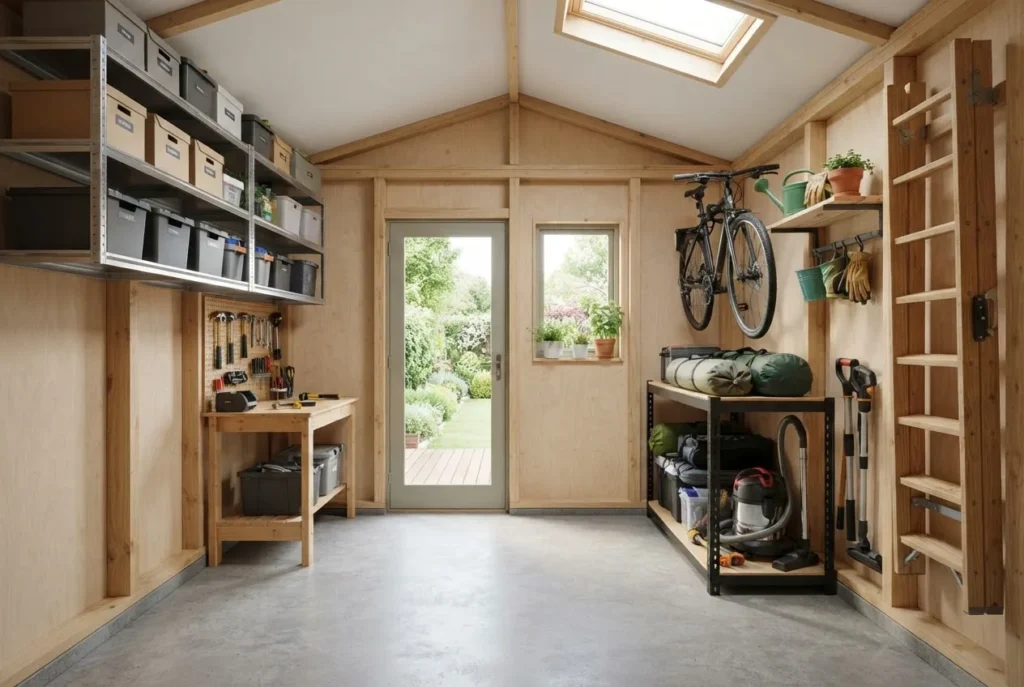
- For sheds used for hobbies or storage, Ironstone hides grime better than lighter colours but needs occasional washing to look fresh.
- For homes, ensure attic insulation is sized to counteract heat gain from a dark roof; consult a builder for R-value targets suited to Melbourne.
- Budget for matching capping and flashings to avoid visual mismatches; for capping choices see roof capping materials.
Transition: The final section summarises whether Ironstone is the right choice for your project and provides a concise set of takeaways and a call to action.
Conclusion: Is Ironstone the Right Colour for You?
Question: Should you choose Ironstone for your next roof or shed project?
Answer: Choose Ironstone if you require a durable, contemporary neutral that complements Melbourne architecture and landscaping; pair with proper insulation and regular maintenance to maximise lifespan and appearance.
- Pros: versatile neutral aesthetic, durable Colorbond paint system, good resale appeal.
- Cons: darker heat absorption, shows dust more readily, requires correct flashing for longevity.
- Practical recommendation: Use Ironstone with sarking and adequate insulation in Melbourne, select Colorbond Ultra in high-exposure sites, and plan maintenance intervals (annual wash, quarterly gutter checks).
If you’re ready to decide, compare supplier datasheets, request on-site samples and speak to a licensed installer to confirm compatibility with your roof profile and warranty requirements. For broader colour coordination on sheds, refer to the pillar guide for the best shed colour options.
External resources: manufacturer specs and compliance can be found via BlueScope Steel technical data and ABCB regulations; paint longevity commentary is available from the Australian Paint Manufacturers Association.
Call to action: For a tailored quote or on-site colour sample, contact a local Colorbond supplier or licensed roofing installer and request a matched Ironstone panel sample to review in your Melbourne microclimate.