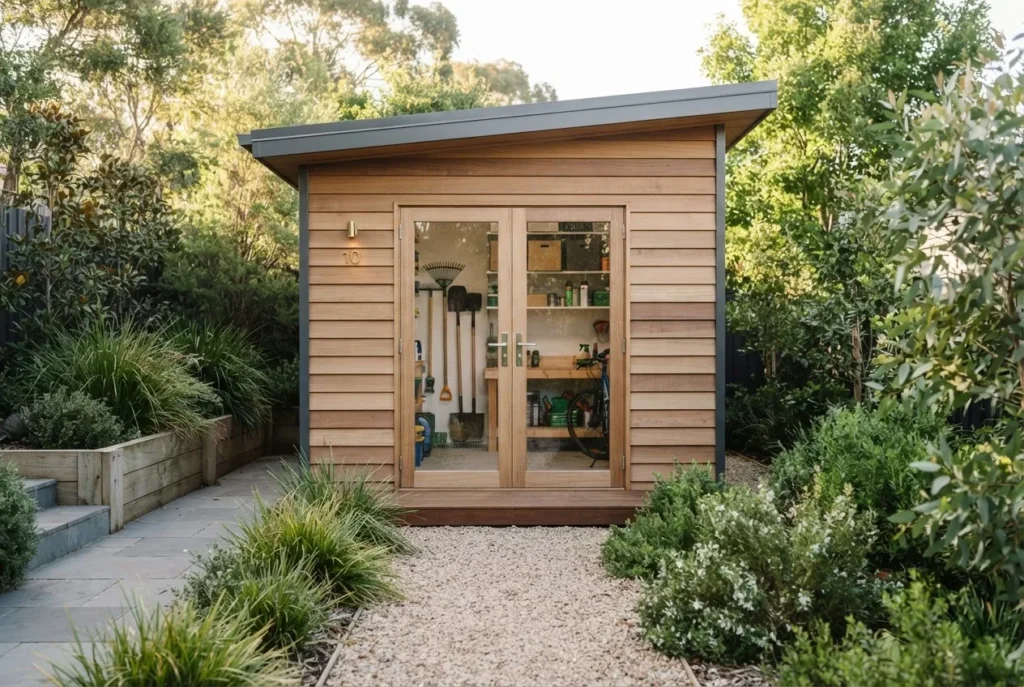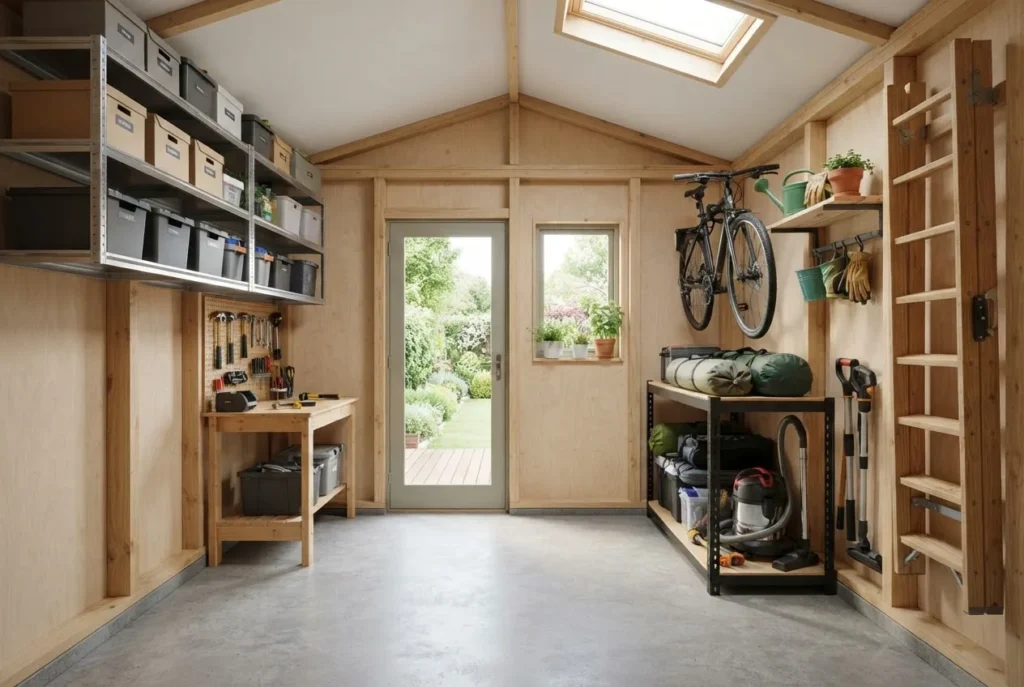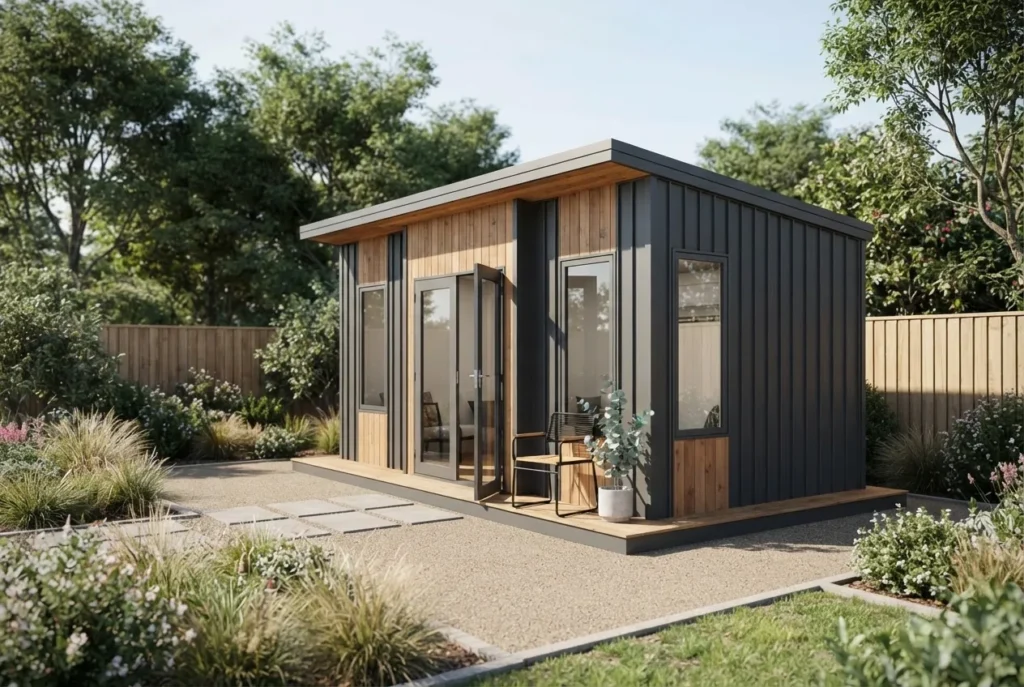

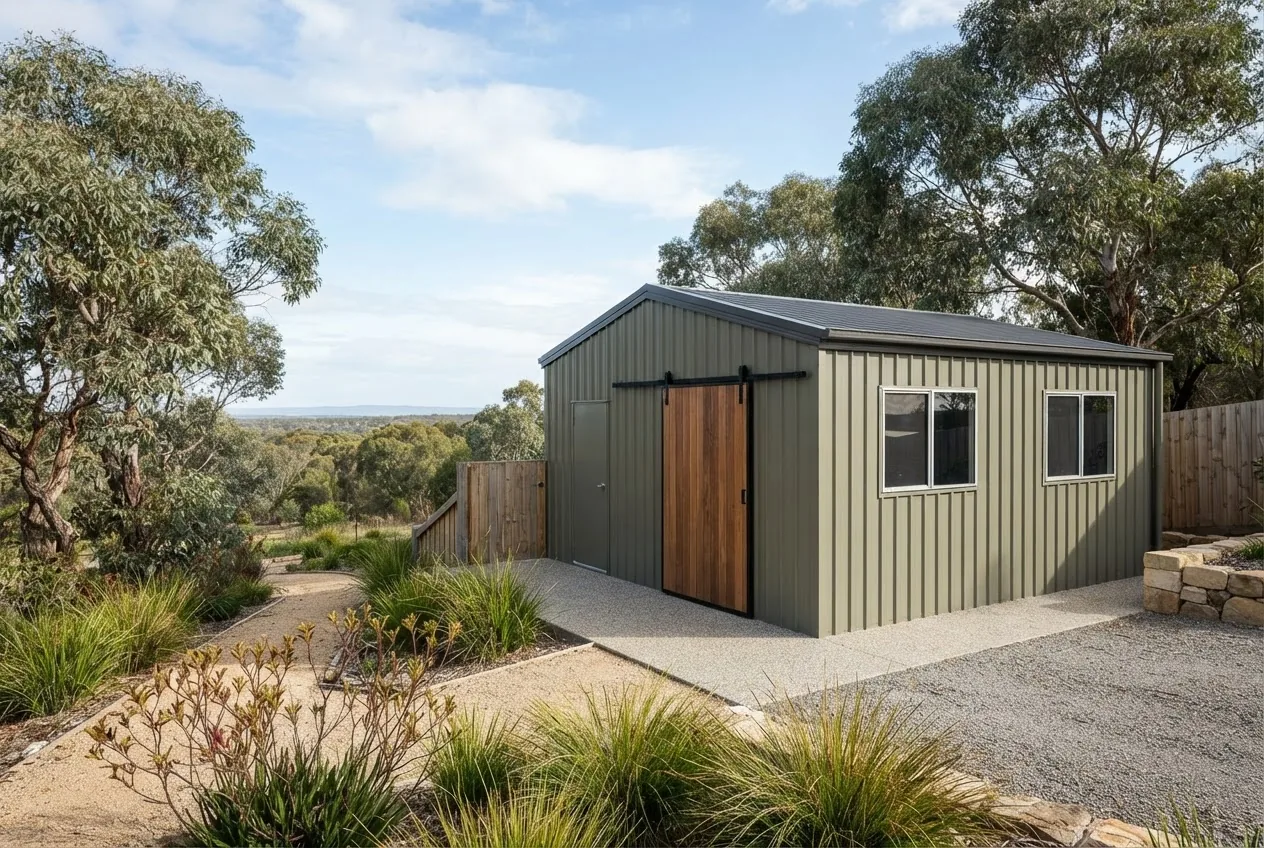

Colorbond Bushland is a mid-toned earthy green-brown pre-painted steel colour designed to blend with native Australian bushland; this guide explains its paint finishes, steel grades, shed uses, UV resistance, maintenance and Melbourne-specific suitability to help you choose and apply Bushland correctly.
Overview of Colorbond Bushland Colour?
Colorbond Bushland is an earthy, muted green-brown from BlueScope’s Colorbond palette intended to harmonise with native Australian bushland and landscape settings. This direct answer clarifies appearance, finish and primary uses for sheds and outdoor structures.
Term: Colorbond — a trade name for pre-painted steel products produced by BlueScope featuring factory-applied protective paint over a Zincalume® or steel substrate.

Bushland colour reads as a warm, desaturated olive with brown undertones that produces low-contrast integration with eucalypts and dry grasses. In direct sunlight it shows subtle metallic sheen from the factory paint, while in shade it leans more matte and earthy — a useful trait for garden sheds and low-visibility outbuildings.
Appearance notes:
- Low reflectivity compared with lighter shades — reduces glare on nearby surfaces.
- Perceived colour changes with angle and light due to paint sheen and metallic substrate.
- Works well with natural timber, sandstone and muted greys for a cohesive property palette.
Practical takeaway: choose Bushland for sheds and fencing where landscape integration and reduced visual impact are priorities, especially in Melbourne suburbs with native vegetation corridors.
Transition: Next we examine the technical materials and steel grades that underpin Colorbond Bushland’s performance.
Technical Properties of Colorbond Bushland Material?
Colorbond Bushland is a factory-painted steel finish applied to a Zincalume® base or to enhanced Colorbond Ultra steel; this determines corrosion resistance, coating system and expected lifespan for shed cladding and roofing.
Term: Zincalume — a coated steel substrate combining zinc and aluminium layers that offers corrosion protection for steel sheeting.
The standard product stack for Bushland is pre-painted steel comprising the substrate (typically Zincalume or high-strength steel), a primer, a corrosion-inhibiting metallic layer, and a topcoat polyester or PVDF finish. Performance varies by steel grade and paint system: standard Colorbond versus Colorbond Ultra (enhanced corrosion and UV resistance).
Term: Colorbond Ultra — an enhanced Colorbond product with thicker metallic coating and higher-performance paint systems for superior corrosion resistance in severe environments.
Key technical data (stat block)
- Typical substrate: Zincalume® (Zn–Al alloy) or high-tensile structural steel.
- Common coating systems: polyester (standard), Hyperform® or PVDF (premium options available on Ultra).
- Coating thickness: 20–40 microns (primer + topcoat typical for standard Colorbond); up to 50+ microns for premium Ultra variants.
- Corrosion resistance class: general purpose to severe; Ultra targets longer life in coastal and industrial zones.
| Specification | Standard Colorbond | Colorbond Ultra |
|---|---|---|
| Substrate | Zincalume® | Zincalume® with thicker metallic layer |
| Topcoat options | Polyester / siliconised | PVDF / Hyperform® high-UV systems |
| Expected service life (Melbourne) | 20–30 years (good maintenance) | 30+ years (reduced maintenance) |
| Typical uses | Sheds, fencing, light roofs | Coastal or industrial-exposed roofs, long-span structures |
According to a 2023 BlueScope technical data sheet, Colorbond Ultra uses thicker metallic layers and upgraded topcoats to increase corrosion resistance and colour durability in severe environments — relevant if your Melbourne site faces marine spray or industrial pollutants. BlueScope Steel technical data
Mechanical and thermal notes:
- Thermal expansion: steel expands ~10–12 mm per 10 m for 30°C change; design roof fixings to accommodate movement.
- Thermal impact of Bushland: darker than Surfmist but lighter than Monument; absorbs more heat than light colours, affecting shed interior temperature.
- Fastener and edge corrosion: ensure compatible screws and sealants; use neoprene washers and recommended flashings.
Warranty & standards: Colorbond products carry manufacturer warranties; consult Australian Building Codes Board standards for compliance on structural and corrosion requirements. Australian Building Codes Board
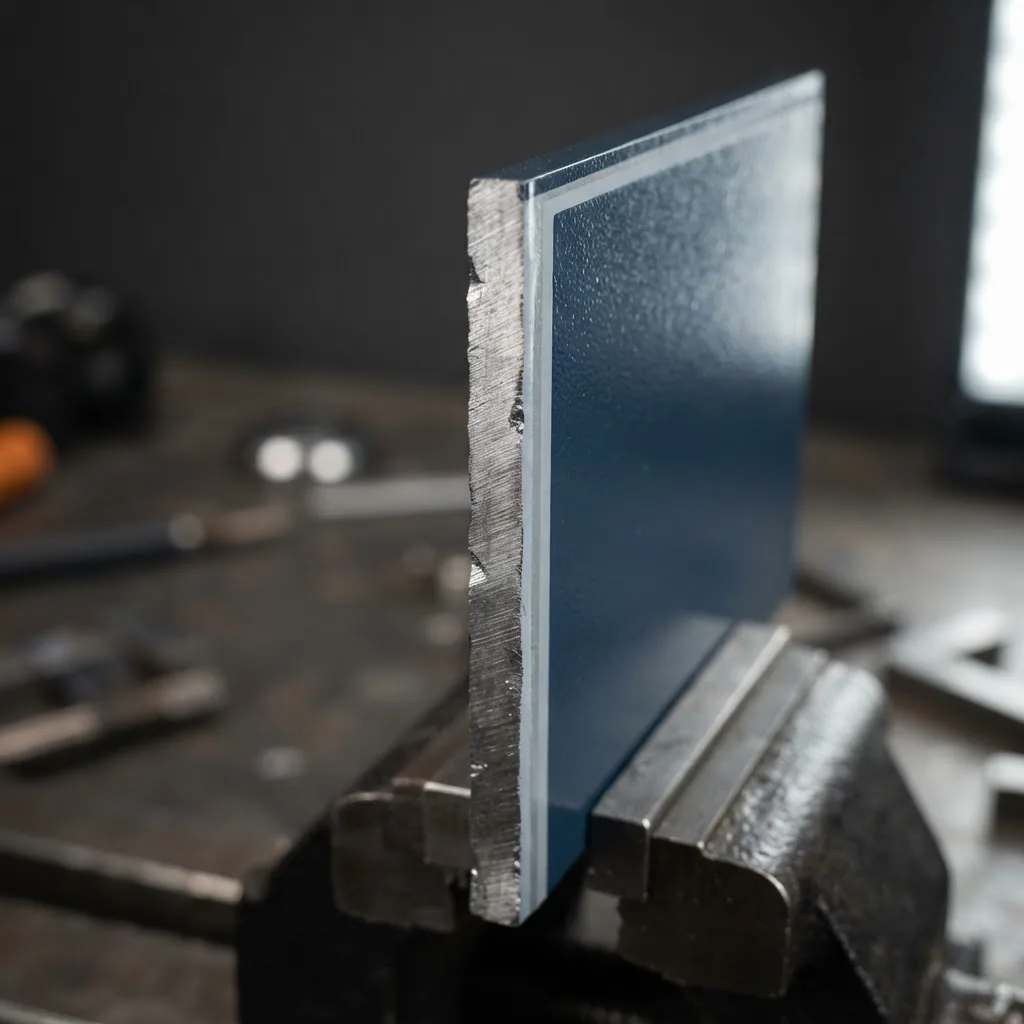
Material snapshot: when specifying Bushland for a shed, select substrate grade based on exposure category — suburban Melbourne typically suits standard Colorbond unless within 1–2 km of the coast or heavy industrial areas.
For enhanced durability, review the features of Colorbond Ultra Steel.
Transition: now that you understand the steel and coating science, we’ll break down available paint and finish options and how they compare for Bushland.
Paint and Finish Options for Colorbond Bushland?
Bushland is available as factory pre-painted Colorbond and can be matched or overcoated with custom paints and maintenance coatings; choose between polyester, siliconised polyester, PVDF and maintenance topcoats depending on durability and budget.
Term: pre-painted steel — steel that has had a factory-applied primer and topcoat bonded to the substrate to form a durable finish.

Step-by-step decision guide:
- Decide durability need: standard suburban use vs coastal/industrial exposure.
- Choose base product: factory Bushland on Colorbond standard or Ultra.
- Select finish system: polyester for cost; PVDF for longevity and UV resistance.
- Consider supplementary coatings: sacrificial maintenance coats or specialised touch-up systems.
- Plan for painting: use recommended primers and painters familiar with metal substrates.
| Finish Type | Advantages | Drawbacks / Cost |
|---|---|---|
| Factory pre-painted (polyester) | Consistent colour, economical, manufacturer warranty | Lower UV resistance than PVDF; mid-range cost |
| Factory PVDF / Hyperform® (Ultra) | Best UV & chemical resistance, longer lifespan | Higher upfront cost |
| Site repaint / custom spray | Custom colour match, repairs, small areas | Requires proper preparation and paint selection; variable longevity |
| Maintenance coatings (touch-up kits) | Extends life, easy spot repairs | Not a substitute for full system failure; recurring cost |
Comparing systems: polyester systems are common for Bushland on standard Colorbond, while Ultra uses higher-performance PVDF/HVLP-applied systems for longer life in severe conditions. For a direct comparison with other paint options like Blue Ridge, see Colorbond paint options like Blue Ridge.
Painting techniques (how-to steps) for site touch-ups and repaints:
- Clean surface thoroughly with low-pressure water and mild detergent; remove all dust, bird droppings and salts.
- Roughen the area slightly with Scotch-Brite or fine abrasive to promote adhesion; wipe with solvent per paint maker’s instructions.
- Apply an etch/metal primer compatible with Zincalume where bare metal is exposed; allow to cure.
- Spray or brush two coats of a recommended metal roof/metal painting system — for roofs use products specified for weather exposure. See tips on roof paint options and flashing techniques.
- Use touch-up kits from the manufacturer for small scratches to maintain warranty compliance.
Cost vs longevity summary:
| Option | Typical cost implication | Maintenance frequency |
|---|---|---|
| Factory polyester | Low–medium | Every 5–7 years |
| Factory PVDF / Ultra | High | Every 10–15 years |
| Site repaint | Variable | Depends on system chosen |
Transition: next we’ll list practical applications of Bushland for sheds, fencing and roofing including related installation considerations.
Applications of Colorbond Bushland in Shed Construction?
Colorbond Bushland is well suited to shed cladding, roofing and fencing where an earthy, low-contrast exterior is desired; it’s appropriate for suburban Melbourne sheds, garden structures and property boundary panels when properly specified.
Term: shed cladding — external wall material used to enclose and weatherproof a shed or outbuilding.
-
Shed cladding (walls) — Bushland performs well as vertical cladding, providing a natural look that reduces visual impact; use standard Colorbond for suburban sites and Ultra where exposure is higher.
Colorbond shed wall materials explain profile choices and fixings.
-
Roofing sheets — Bushland works on corrugated or long-span roof profiles. Consider thermal effects: darker colours increase heat gain; integrate insulation or ventilation in shed design.
roof capping materials and costs are important for durability and water-tightness.
-
Fencing panels — use Bushland for boundary panels to blend with native vegetation; it reduces visual contrast and provides privacy.
Colorbond fencing panels price and material details cover panel height, gauge and installation variations.
-
Gates and hardware — match gates to Bushland cladding for a cohesive aesthetic; select corrosion-resistant hinges and hardware, particularly in damp Melbourne pockets.
fence gate sizes and installation cost provides sizing and cost guidance.
-
Commercial and large-span buildings — Bushland is available for larger steel buildings though specification should be checked against solar heat gain and interior light levels.
steel building material options and costs are relevant for larger sheds or workshops.
- Flood-prone or exposed sites — choose Ultra-grade materials when exposure to salt spray or airborne contaminants is identified in site assessment.
- Cladding repair and patching — for repairs, use manufacturer-supplied touch-up paint and primers to maintain corrosion protection and warranty validity.
- Insulation and ventilation integration — Bushland cladding accepts typical insulation fixings; ensure condensation control with breathable membranes and ventilation gaps for metal roofs.
- Fasteners and flashings — use compatible stainless or plated fasteners and colour-matched flashings; see flashing choices in the capping guide above for compatibility metrics.
- Fencing and landscape integration — Bushland is often paired with native plantings to create property screening and reduce the visual footprint of the shed.
- Panel profiles and sheet types — select corrugated, tray or custom profiles depending on load, appearance and run length considerations; for profile guidance see long-span and tray roofing resources.
- Regulatory and compliance considerations — check local council requirements for colour and visual amenity in bushland settings and fire-prone area regulations for cladding materials.
- Accessory compatibility — gutters, downpipes and cappings should be specified to match Bushland where visible; coordinate with fascia and gutter options when ordering.
Transition: after covering applications, the next section explains colour matching and complementary palettes to integrate Bushland into your exterior scheme.
Colour Matching and Complementary Colour Schemes for Bushland?
Use complementary natural palettes—soft greys, muted tans and timber tones—to pair with Bushland; for a broader selection of harmonious shed colours see our recommended choices on the pillar page.
Term: complementary colours — colours selected to harmonise or balance a primary colour in an exterior palette.
Practical pairings:
- Neutral trims: Gull Grey or Surfmist for contrast on fascias and trims.
- Timber accents: natural spotted gum or merbau staining complements Bushland’s brown undertones.
- Stone and paving: warm sandstone or muted grey bluestone pair well for base material.
- Metalwork: use dark grey or Monument sparingly for sharp visual accents.
Example palettes with use-cases:
- Garden studio: Bushland walls, Surfmist trims, natural timber door — reduces visual mass and brightens edges.
- Workshop in suburban Melbourne: Bushland roof and walls, Gull Grey gutters and trims, concrete floor — functional, low-contrast.
- Rural outbuilding: Bushland cladding, sandstone paving, timber posts — blends into eucalypt-dominated landscape.
To explore more options across the Colorbond palette and compare alternatives to Bushland, visit our central colour guide: best Colorbond shed colour options.
Transition: matching colours is only part of the lifecycle picture — the following section covers maintenance to protect Bushland’s appearance and performance.
Maintenance and Longevity of Colorbond Bushland Materials?
Colorbond Bushland will last decades with correct maintenance: regular cleaning, prompt touch-ups of damage, corrosion prevention and inspection of flashings and fasteners extend service life.
Term: corrosion prevention — practices used to stop or slow metal degradation, including appropriate coatings, compatible fasteners, and drainage design.
- Routine washing: clean panels annually (or after heavy pollen/salt events) with low-pressure water and mild detergent to remove salts and organic deposits.
- Inspect flashings and fasteners: check screws and sealants every 12 months; replace neoprene washers and tighten loose fasteners.
- Touch-up paint: use manufacturer touch-up kits within weeks of noticing scratches to prevent bare metal exposure; follow application steps in the Paint and Finish section.
- Remove vegetation contact: prevent leaves and branches from lodging against cladding to reduce moisture retention and staining.
- Monitor gutters and drainage: clear gutters to avoid standing water at eaves, which accelerates corrosion at edges.
- Address chalking/fading: deep fading may require professional repainting with compatible metal roof paints; expect repaint intervals of 10–15 years for premium systems, 5–10 for standard systems.
- Warranty checks: retain purchase documentation; manufacturer warranties often require evidence of proper maintenance.
- Special exposures: if within 2 km of the coast, increase inspection frequency and consider Ultra-grade materials for longer performance.
Real-world example: a 3x4m garden shed built in Melbourne’s inner-east in 2020 using Bushland standard Colorbond required a minor touch-up in year 3 after a storm scratched a corner; annual washes prevented staining and the cladding remained blemish-free by year 5—illustrating typical suburban outcomes with correct upkeep.
Transition: with maintenance clarified, the next section focuses specifically on Melbourne’s climate and how it affects Bushland selection.
Environmental and Climate Suitability for Colorbond Bushland in Melbourne?
Colorbond Bushland suits Melbourne’s temperate climate, but UV exposure, seasonal rainfall and urban pollutants influence finish choice and maintenance; Ultra systems are recommended in coastal fringe or high-pollutant zones.
Term: UV exposure — ultraviolet radiation from sunlight that causes accelerated paint degradation and colour fade.
Regional notes for Melbourne:
- UV and sunlight: Melbourne has moderate to high UV index in summer; PVDF finishes resist fade better than standard polyester. According to a 2024 industry report, higher-grade PVDF finishes retain >85% colour integrity after 10 years in temperate climates.
- Temperature swings: large day-night swings can increase thermal cycling; allow for thermal movement in fixings.
- Rain and salt: inner Melbourne has low coastal salt exposure but some bayside suburbs may require upgraded materials.
- Pollutants: urban industrial zones increase corrosion potential—assess site and consider Ultra where required.
Local compliance and fire risk: check council requirements for bushfire-prone areas; metal cladding generally performs well but ensure eave and penetration detailing meets the Australian standards listed by the Australian Building Codes Board. Australian Building Codes Board
Transition: having covered climate suitability, we’ll summarise cost and availability considerations.
Cost Implications and Availability of Colorbond Bushland Materials?
Colorbond Bushland pricing sits above plain Zincalume due to factory paint; expect higher prices for Ultra-grade and PVDF finishes — total project cost depends on sheet gauge, profile, and installation complexity.
Cost factors to consider:
- Material grade: standard Colorbond is less expensive than Ultra; premium paint systems add to material cost.
- Sheet profile and length: long-span sheets reduce seams but increase handling costs.
- Installation: labour, flashings, sealants and fasteners vary by access and roof pitch.
- Accessories: gutters, downpipes, capping and custom flashings add to total expense; see “roof capping materials and costs” for detail.
Estimated cost ranges (indicative, Melbourne suburbs, 2024 market context):
| Item | Typical unit cost | Notes |
|---|---|---|
| Zincalume sheet (per m²) | AUD 12–18 | Base non-painted option |
| Colorbond Bushland (standard) (per m²) | AUD 22–32 | Includes factory paint; varies by profile and thickness |
| Colorbond Ultra Bushland (per m²) | AUD 30–45+ | Higher-cost premium finish; recommended for severe exposures |
| Installation (labour) per m² | AUD 40–90 | Depends on access, pitch, profile and site conditions |
For budget-conscious buyers exploring alternatives or lower-cost panels, consider reviewing cheap roofing sheets options for price comparisons and trade-offs.
For detailed roofing cost breakdowns, see Colorbond roof price per square meter.
Supply and lead times: Bushland is a standard Colorbond colour and widely stocked, but specific profiles and Ultra grades may have lead times — confirm with suppliers and order matching flashings together to avoid delays.
Transition: final summary and action steps follow, with practical takeaways and a CTA.
Conclusion and Next Steps?
Choose Colorbond Bushland for sheds when landscape integration and a low-contrast, natural aesthetic matter; specify Ultra-grade PVDF finishes only where exposure or longevity demands the extra cost. Balance thermal effects, maintenance commitment and budget when planning a Bushland-clad shed in Melbourne.
Key takeaways:
- Bushland is an earthy green-brown factory finish best for blending with native landscapes.
- Standard Colorbond suits most Melbourne sites; choose Colorbond Ultra for coastal or industrial exposure.
- Factory PVDF finishes increase UV and corrosion resistance—factor this into lifecycle cost estimates.
- Maintain with annual washing, prompt touch-ups and regular inspection of flashings and fasteners.
Resources and authority references: manufacturer technical sheets and building standards are essential when specifying materials — consult BlueScope for technical data (BlueScope Steel technical data), local compliance via the Australian Building Codes Board, and independent studies on metal durability from CSIRO Australia. According to a 2024 industry report, specifying Ultra-grade paint systems extends service life by up to 30% in severe conditions.
Ready to specify Bushland for your shed? Gather site exposure details and preferred profiles, request BlueScope colour passes from suppliers, and ask for matching flashings and touch-up kits at order time to secure a consistent finish and warranty coverage.