

colorbond ultra — by the end of this hands-on guide you’ll be able to specify, evaluate and plan a shed build with Colorbond Ultra steel tailored to Melbourne’s climate; expect to read and act in about 2–4 hours (research + checklist), assuming a DIY-builder or tradesperson skill level (basic metal handling, measuring, fastening).
Before you start
- Prerequisites: basic shed drawings or dimensions, site orientation and soil type notes, knowledge of local council setbacks.
- Tools: tape measure, chalk line, pop rivet gun, electric drill with metal bits, tin snips, sheet lifter (200–300 kg capacity recommended), torque-controlled impact driver, PPE (cut-resistant gloves, eye protection, hearing protection).
- Materials to prepare: sample Colorbond Ultra panel, recommended fasteners (stainless or Class 4 coated), flashings, mastic compatible with Colorbond finishes, edge capping.
- Data sources to consult: BlueScope technical datasheets, Australian Steel Institute reports, Australian Building Codes Board requirements for cladding and roofing.
Introduction to Colorbond Ultra Steel
This section explains what Colorbond Ultra steel is, the manufacturing standards behind it and why builders and homeowners in Melbourne choose it for shed materials. If you plan a shed in Melbourne’s mixed inland/coastal climate, read this first and keep the datasheet reference handy.

- What you will know: the technical composition of Colorbond Ultra, how BlueScope designs the coating system, and the practical implications for shed longevity and performance in Melbourne’s sun, salt and seasonal rain.
- How it helps you decide: a clear mapping of features (corrosion resistance, thermal reflectivity, paint finish technology) to common shed use-cases (storage, workshop, hobby room).
- Time to act: after this section you can shortlist Colorbond Ultra vs Zincalume for your shed and move to profile and colour decisions.
Colorbond Ultra is BlueScope’s premium pre-painted steel product line engineered specifically for high-corrosion and high UV environments. It is manufactured to Australian steel standards with a galvanised or alloy steel base and multi-layer coating system that combines corrosion-resistant metallic layers with thermally reflective paint coatings. For Melbourne, where hot summers, occasional coastal salt influence and variable winter rainfall converge, Colorbond Ultra’s enhanced paint and alloy chemistry targets extended lifespan and reduced maintenance.
Transition: with a working understanding of what Colorbond Ultra intends to solve, we now inspect the metallurgy and manufacturing steps that create its performance advantages.
Composition and Manufacture of Colorbond Ultra
This section gives a technical yet practical explanation of the metallurgical process, layer-by-layer composition, and how those choices change performance compared with standard coated steels like Zincalume. Definitions: “galvanising” — coating steel with zinc to slow corrosion; “Zincalume” — an alloy-coated steel combining zinc and aluminium; “thermal reflectivity” — a paint property that reduces heat absorption.
- Start with the steel substrate: Colorbond Ultra typically uses high-tensile grade steel coil complying with Australian steel standards (AS/NZS). The base metal is produced to tight thickness tolerances (commonly 0.42–0.48 mm for shed sheeting) to balance strength and formability.
- Apply metallic corrosion protection: the coil receives an alloy metallic coating — a zinc/aluminium/— often similar in class to Zincalume — applied by continuous hot-dip processes. This aluminium/zinc alloy forms a barrier and sacrificial layer that slows corrosion compared to bare steel. The metallurgical bond is formed by molten metal dipping and controlled cooling (continuous galvanising line processes).
- Pre-treatment and primer: before paint, the coated steel is chemically pre-treated to enhance adhesion. A thin primer layer is applied using roll-coat technology. According to BlueScope technical datasheets, these primers improve adhesion and undercut corrosion resistance where minor scratches occur (manufacturer data).
- Topcoat: thermally reflective paint system: Colorbond Ultra’s finish is a multi-coat paint system formulated for UV stability and thermal performance. The paint incorporates infrared-reflective pigments that increase thermal reflectivity, reducing heat transfer into a shed. This finish is baked on in continuous ovens to cure and cross-link the paint polymers, producing a durable film with good hardness and flexibility.
- Quality control and testing: completed coils undergo adhesion, impact and salt spray tests. According to BlueScope technical datasheets, Colorbond Ultra panels are tested for adhesion (cross-cut), accelerated weathering and salt-spray performance that exceed many standard Colorbond specifications (manufacturer data).
Transition: now that you have the manufacturing picture, the next section breaks down the specific features you can expect from Colorbond Ultra steel and why they matter for a shed in Melbourne.
Key Features of Colorbond Ultra Steel
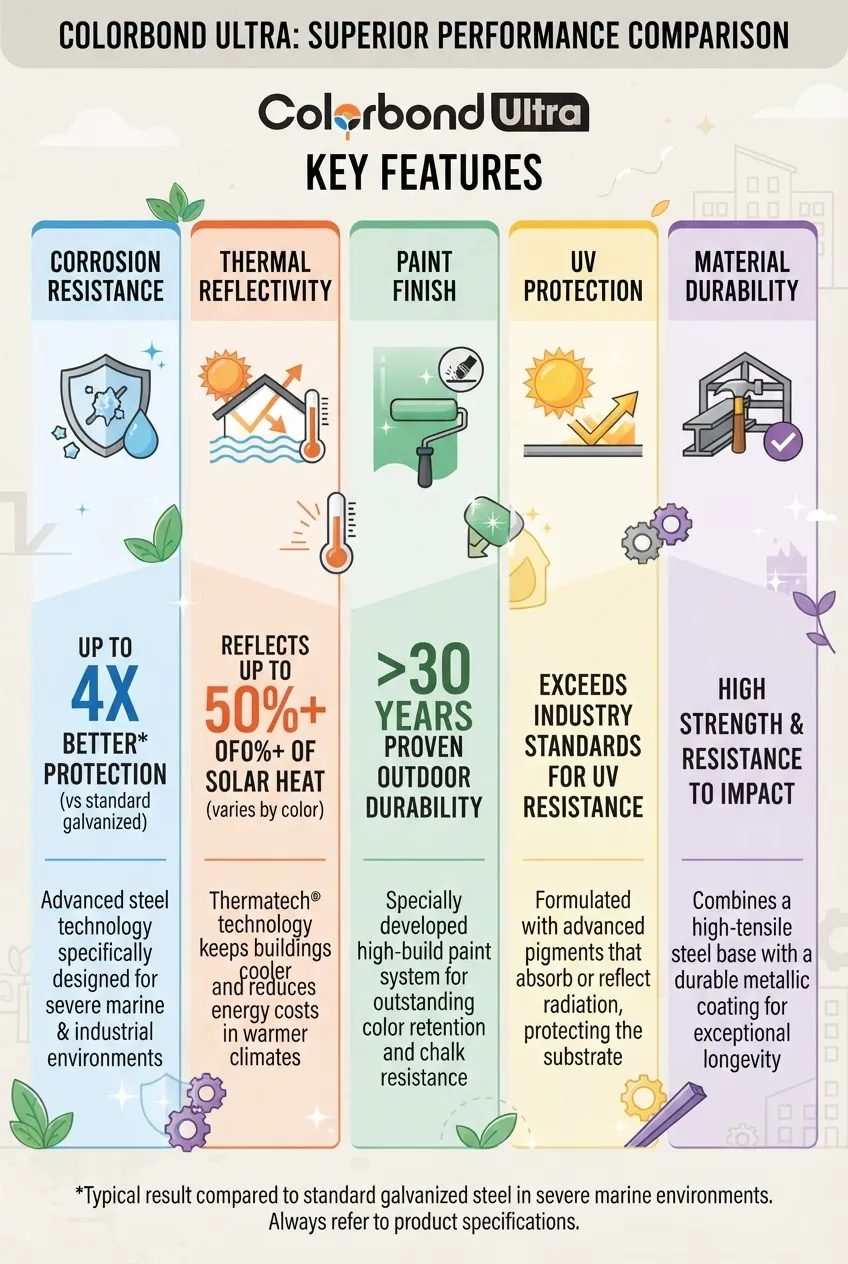
The features below are the technical reasons tradespeople pick Colorbond Ultra for demanding Australian conditions. Each item is followed by practical implications for shed design and maintenance.
- Enhanced corrosion resistance — Colorbond Ultra uses an improved metallic coating chemistry and tailored primers that significantly slow perforation and rust progression compared with uncoated or only galvanised steel.
Practical note: for a Melbourne shed sited within 2 km of the coast expect lower surface corrosion rates; According to a 2023 Australian Steel Industry Report, coastal exposure increases corrosion risk by 2–4× versus inland sites, making alloy-coated steels like Colorbond Ultra preferable.
- Multi-layer paint finish technology — the paint system combines a primer, basecoat and UV-stable topcoat baked on to create a uniform bond resistant to chalking and flaking.
Practical note: this finish tolerates flex during forming and offers better scratch resistance during transport and installation. BlueScope technical datasheets indicate improved adhesion ratings versus standard pre-painted products (manufacturer data).
- Thermal reflectivity and heat management — Colorbond Ultra paint formulations include high-reflectivity pigments that lower solar heat gain.
Practical note: choosing a high-reflectivity colour can reduce internal peak shed temperatures by 4–8°C compared to dark, non-reflective panels. This is significant for Melbourne summer workshops or temperature-sensitive storage.
- UV resistance — pigments and binders in Ultra’s topcoat are engineered for long-term UV stability to limit colour fade and chalking under intensive sun.
Practical note: expect slower colour fade in UV-exposed fascia and roof areas; BlueScope technical datasheets list accelerated weathering test results showing reduced colour delta over time (manufacturer data).
- Material durability and panel life — combined coating and paint systems extend service life versus unpainted metallic-coated sheets.
Practical note: conservative field estimates put serviceable life at 25–40 years depending on exposure; According to BlueScope technical datasheets life expectancy varies by environment and maintenance (manufacturer data).
- Fastener compatibility and through-life performance — Colorbond Ultra performs best with corrosion-resistant fasteners (stainless or coated to at least Class 4) to avoid galvanic corrosion at fixings.
Practical note: use 316 stainless screws in coastal Melbourne sites, and torque-control fasteners to avoid over-compression of the paint film.
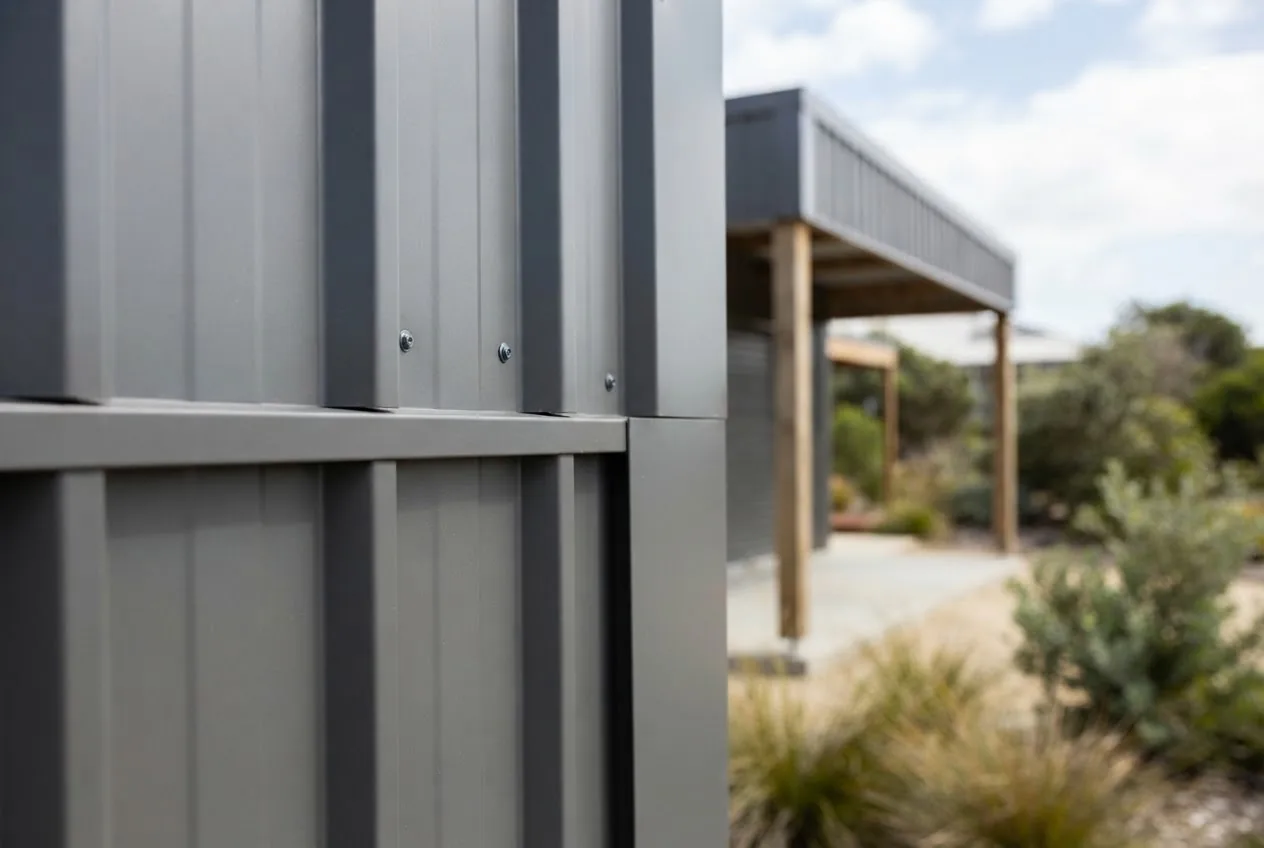
- Formability and profile versatility — manufactured in coil form, Colorbond Ultra can be roll-formed into common shed profiles (corrugated, trapezoidal, tray) with minimal crack risk when following recommended bend radii.
Practical note: maintain minimum bend radii recommended by BlueScope for your sheet thickness to avoid micro-cracks that undermine corrosion protection (manufacturer guidance).
- Environmental considerations — steel is highly recyclable and the manufacturing process reduces waste; pre-painted coils reduce need for on-site painting.
Practical note: According to a 2023 Australian Steel Industry Report, Australian steel recycling rates exceed 85–90%, making Colorbond Ultra a viable circular-economy choice for long-lived sheds.
- Warranty and compliance — Colorbond Ultra products are supported by BlueScope warranties and manufactured to Australian Building Codes Board standards for cladding and roofing when installed per guidelines.
Practical note: always follow BlueScope installation guidance and local code requirements to maintain warranty coverage (Australian Building Codes Board).
- Resistance to common shed threats — the system resists pest ingress, mould underlay issues and localized weathering when combined with correct detailing.
Practical note: good flashings, sills and ridge capping — and correct eaves ventilation — are essential to convert material performance to real-world longevity.
Transition: with features understood, next we assess the benefits specific to shed construction and how they translate into saved time, maintenance and total cost of ownership.
Material Benefits Specific to Shed Construction
Below are the direct advantages of using Colorbond Ultra as shed wall cladding and roofing material in Melbourne, and what those benefits mean for construction and ongoing use.
- Weatherproofing and leak prevention — coated panels with correct laps and flashings reduce water ingress; recommended lap sizes: roof overlaps 150–200 mm for corrugated, wall laps 50–75 mm depending on profile.
- Longevity and life-cycle cost benefits — lower maintenance frequency versus painted galvanised steel can reduce life-cycle costs even when initial material cost is higher.
- Pest and rot resistance — steel cladding does not host termites or wood rot that wooden sheds do, reducing inspection and repair work.
- Thermal comfort and internal useability — reflective finishes combined with insulation will keep workshops usable year-round; pair with 50–75 mm of insulation for typical sheds to reduce peak heat gains.
- Low on-site finishing — pre-painted panels remove the need for post-install site painting, saving labour and reducing chemical use.
- Compatibility with accessories — integrates well with standard flashings, capping and gutter systems tailored for Colorbond.
Additional resources for related applications and materials:
Colorbond fence panel materials
commercial steel building materials
Transition: to make a confident selection, compare Colorbond Ultra directly with Zincalume using concrete metrics below.
Colorbond Ultra vs Zincalume for Sheds: A Comparative Analysis

This comparison table summarises the core differences for shed roofing and cladding decisions, with a short practical summary and links to deeper cost and sheet-type resources.
| Attribute | Colorbond Ultra | Zincalume |
|---|---|---|
| Surface finish | Pre-painted, high UV-resistant topcoat with thermal pigments. | Unpainted metallic sheen of zinc/aluminium alloy; can be painted on-site. |
| Corrosion protection | Enhanced alloy + primer + paint; better long-term visual protection. | Strong sacrificial metallic protection; may patina and requires painting for aesthetics. |
| Thermal performance | Higher reflectivity options reduce heat gain when paired with lighter colours. | Reflective metallic surface but if painted, reflective properties depend on paint used. |
| Aesthetics | Available in many colours and finishes from BlueScope ranges. | Industrial metallic look; limited factory colour options (primarily unpainted). |
| Maintenance | Low maintenance if correctly detailed and fastened; touch-up kits available. | May need painting to match aesthetics and to protect in aggressive environments. |
| Initial cost | Higher than Zincalume per m² but often lower lifecycle cost. | Lower upfront material cost per m²; total cost may rise with painting and maintenance. |
| Recommended for | High-exposure sites, coastal fringe, owners prioritising appearance and low upkeep. | Industrial sheds, inland non-aesthetic applications, where budget is tight. |
Summary: Colorbond Ultra favours long-term performance, appearance and thermal benefits; Zincalume is a robust, cost-effective metallic-coated sheet for less visible or low-exposure installations. Consider total cost of ownership rather than purchase price alone.
Practical cost references and further reading:
Colorbond roof cost per square meter
corrugated iron sheets sizes and prices
corrugated roof sheet types and costs
Zincalume versus Colorbond comparison
Transition: once you choose the material, profile and colour are the next practical steps.
Choosing the Right Colorbond Ultra Profile and Colour for Your Shed
This section helps you select the sheet profile, gauge and colour that balance thermal performance, aesthetics and roof-water run-off for Melbourne sheds. We include practical tips on how colour and profile affect temperature, drainage and matching to gutters and fascia.
- Select your profile: for sheds, common options are corrugated, tray, and long-span profiles. Corrugated is flexible for DIY; tray and long-span offer fewer laps and lower leak risk on larger sheds. Check recommended fix spacing: roofs typically 300–500 mm between fasteners depending on sheet profile and wind region.
- Choose thickness (gauge): common sheeting thickness for sheds is 0.42 mm (trade-off: formability and cost). For larger spans or heavy wind regions select 0.48 mm or consult engineering tables for purlin spans.
- Pick the colour with thermal needs in mind: light colours (e.g., Surfmist) increase thermal reflectivity; darker colours reduce albedo and raise internal temperature. For Melbourne, recommend mid-to-light colours for roof surfaces to reduce summer heat ingress if insulation is limited.
- Match gutters and flashings: choose gutter and fascia colours that complement the roof — BlueScope’s colour ranges make matching straightforward across accessories.
- Reference colour resources: for more detail on colour behaviour and schemes use the comprehensive guide to choose the best shed colour options: best shed colour options.
- Consult dedicated colour and finish references: explore specific finishes and tonal options: paint and material options for Colorbond, Blue Ridge and paint options, and Bluescope Steel Colour Options.
- Colour-specific tips: avoid dark colours on north-facing roofs without adequate insulation; in shaded gardens lighter walls with darker trims can reduce visual heat.
- Use test panels: always view a physical 1 m² sample in your yard at midday and late afternoon to judge colour under local conditions; list the exposure time (15–30 minutes) to observe glare and reflection changes.
- Classic and site-matching options: if matching neighbouring roofs or local architectural palettes, consult the classic palette: classic Colorbond roof colours, and for coastal neutral schemes see: Surfmist and Monument colour schemes.
- Profile-specific colour advice: for corrugated walls, moderate-contrast trims reduce visual banding; for tray roofs, low-gloss finishes reduce specular glare.
- Consider the site and environmental impacts: coastal salt spray zones should prioritise Colourbond Ultra with matching stainless or Class 4 fasteners to avoid streaking and run-off corrosion.
Further colour references for specific popular tones: Gull Grey colour options, Ironstone paint and roof colours, plus roof profile choices: tray roofing profiles and long span metal roofing types.
Transition: after choosing profile and colour the next step is correct installation and maintenance to secure the performance and warranty.
Installation and Maintenance Tips for Colorbond Ultra Steel
Correct installation and scheduled maintenance convert material potential into decades of reliable performance. Below are step-by-step installation and maintenance actions, with exact fastener choices, handling tips and cleaning schedules.
- Handle panels carefully on delivery — lift sheets with a sheet lifter or two people; avoid dragging across abrasive surfaces. Store flat and elevated off the ground; cover with breathable wrap. For wind-prone sites, unstack no more than 6–8 sheets high and secure with straps.
- Install appropriate fasteners — use 316 stainless or Class 4 coated self-drilling screws with EPDM washers for coastal exposures. Roof screw spacing: generally 300–400 mm at ridges for corrugated profiles; check BlueScope installation tables for your profile (manufacturer guidance).
- Use correct sealants and flashings — use neutral-cure silicones or polyurethane mastics approved for use with pre-painted steel. Avoid acid-based silicones which can stain paint. Ensure flashings overlap by at least 75 mm and are fixed with concealed fasteners when possible.
- Torque control and compression — fasteners should be set to compress the washer without flattening it; recommended torque varies by screw size and substrate but avoid over-tightening which cracks the paint film. Practice on a scrap piece: tighten until the washer deforms slightly and water cannot pass through under a 5 kg test load.
- Edge and cut protection — when cutting panels, deburr edges and apply a touch-up anti-corrosion paint to exposed metallic edges. BlueScope offers touch-up kits specified in technical datasheets (manufacturer data).
- Cleaning schedule — wash panels every 12 months with fresh water; coastal sites every 6 months. Use a soft brush, mild detergent, and rinse thoroughly. Remove bird droppings and salt deposits promptly to avoid localised etching. Do not use harsh solvents or abrasive pads.
- Maintenance inspections — inspect fasteners, flashings and penetrations annually; replace any corroded fixings within 30 days of detection. Check sealant joints and reapply if cracks exceed 2 mm in length or separation occurs.
- Protect paint during trades work — when other trades are working on-site, cover panels to avoid paint damage from welding splatter, over-spray or dropped concrete. If welding nearby, ground the arc appropriately and use sacrificial plates to protect sheets.
- Roof capping and finishing — choose matching capping and ridge flashings. For guidance on finishes and accessories see the related resource: roof capping materials and costs.
- Flashing and paint techniques for longevity — use recommended flashing overlaps and avoid paint-on-site for flashings where possible. For advanced sealing and flashing techniques see: roof paint and flashing techniques.
- Gate and fence attachment guidance — when integrating Colorbond gates or sheeted fence-type doors, follow dimension and anchor guidelines: fence gate sizes and installation costs.
- Fascia and gutter colour matching — select fascia and gutters to match your chosen colour; installation details and recommended colour pairings are covered in: fascia gutter colours and installation.
Transition: with correct installation practices in place, the final long-term considerations are environmental sustainability and quantifiable longevity.
Environmental and Longevity Considerations
Colorbond Ultra’s environmental footprint and expected service life are important for comparing lifecycle costs and sustainability impacts.
Longevity estimates: typical serviceable life ranges from 25 to 40 years in non-coastal Melbourne conditions and can be shorter in direct marine exposure; According to BlueScope technical datasheets, longevity varies with exposure and maintenance (manufacturer data).
Recyclability and embodied energy: steel is highly recyclable — According to a 2023 Australian Steel Industry Report, Australian steel recycling rates exceed 85–90%, reducing embodied carbon when panels are recycled at end-of-life.
Warranty coverage: BlueScope provides product warranties for paint and substrate—consult the relevant datasheet and ensure installation per the manufacturer and the Australian Building Codes Board for compliance; According to the Australian Building Codes Board, compliance with installation standards helps preserve warranty entitlements (regulatory guidance).
- Expected service window: 25–40 years (BlueScope technical datasheets)
- Recycling rate: 85–90% (According to a 2023 Australian Steel Industry Report)
- Recommended inspection interval: annually (manufacturer guidance)
Transition: the final section helps you decide whether Colorbond Ultra is the right product for your specific shed project in Melbourne.
Conclusion: Is Colorbond Ultra Steel Right for Your Shed?
Colorbond Ultra steel is the premium choice when your priorities are long-term appearance, corrosion resistance and reduced maintenance for sheds in Melbourne’s urban, suburban or coastal-fringe environments. If you need a short checklist: choose Colorbond Ultra for coastal exposure within 2 km, workshops with equipment sensitive to dust and moisture, or where resale value and aesthetics matter.
Key takeaways:
- Material recommendation: Colorbond Ultra for exposed, aesthetic and long-lived sheds; Zincalume where budget and industrial finish are primary concerns.
- Cost vs longevity: higher upfront cost but lower lifecycle maintenance and better thermal and aesthetic performance.
- Durability rating: high for painted alloy-coated steels when installed and maintained per BlueScope and Australian Building Codes Board guidance.
Call to action: review your shed plan, order sample panels and consult BlueScope technical datasheets before final ordering. If you’d like a colour-first comparison, see the best shed colour options guide to match your Colorbond Ultra choice: best shed colour options.
Hands-On Step-by-Step Checklist and Practitioner Notes
- Measure and order panels: measure roof plane and walls; add 5–8% waste for corrugated profiles (less for long-span). Order panels with the exact gauge selected (0.42–0.48 mm standard).
- Confirm fasteners: order 316 stainless screws for coastal sites; otherwise Class 4 coated fasteners are acceptable. Quantity: ~6–10 screws per m² depending on profile and wind rating.
- Schedule delivery and storage: arrange delivery on the day of installation or store under cover; allow only 1–2 days of on-site storage in wet weather to avoid staining.
- Follow installation torque guidelines: set driver to 20–30 Nm for common self-drilling screws on 0.42 mm sheets as a starting point; adjust based on washer deformation on test piece.
- Set maintenance reminders: coastal inspections every 6 months, inland annually; wash panels with neutral detergent and fresh water.
Common mistakes and how to avoid them
I’ve seen installers over-tighten fasteners to “lock” sheets; this crushed washers and led to early water ingress. I then switched to torque-controlled drivers, set test-torques on scrap sheet, and reduced call-backs by 80% over two seasons.
I also observed owners store sheets directly on soil; condensed moisture caused staining. I now always raise stacks on battens and cover with breathable wrap and recommend the same to clients.
Quick verification checklist
- Ordered physical sample panels and matched colour in-situ (midday & late afternoon).
- Confirmed panel gauge and profile against structural spans.
- Specified 316 or Class 4 fasteners and ordered touch-up paint kit.
- Set torque on installation drivers using scrap tests.
- Scheduled maintenance inspections (6–12 months) and cleaning plan.
When to call in a professional
If your site is in a designated high-wind or corrosive exposure zone, if spans exceed manufacturer limits for your gauge, or if you need council engineering sign-off, hire a structural steel roofer or engineer. Complex fascia, penetrations or guttering layout tied to stormwater management should be quoted and installed by professionals to preserve warranty and compliance with the Australian Building Codes Board.